


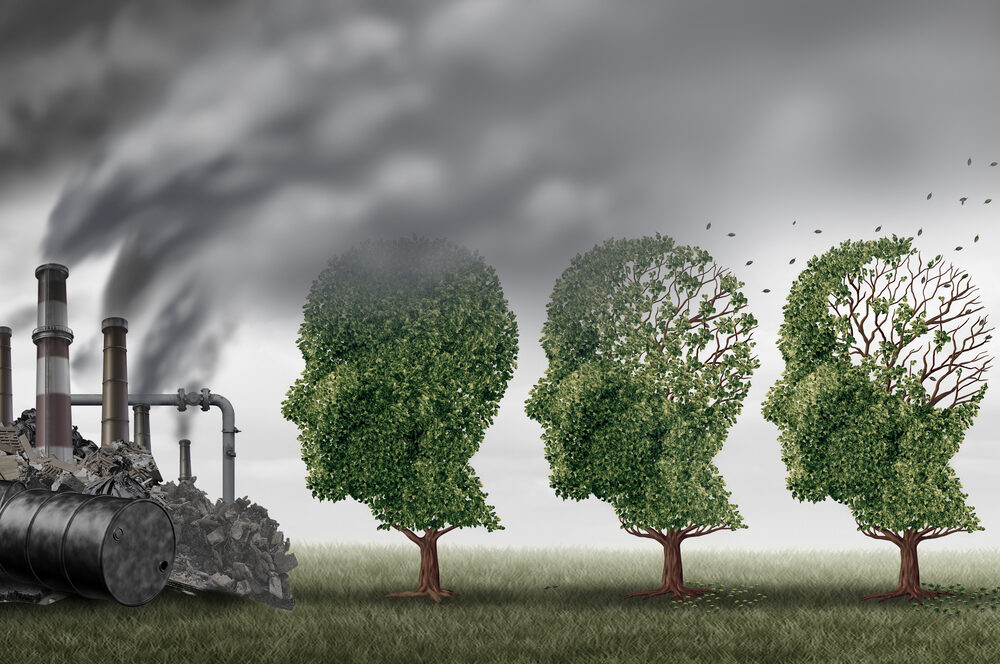
Older adults who lived in areas with high air pollution levels early in the 2000s scored significantly worse on memory tests in 2011 than their peers in low-pollution communities, even if air quality improved in the meantime, according to a new study.
The magnitude of the decline was comparable to roughly two to six years of cognitive aging, or the gradual changes in thinking and memory that occur with age.
Published this month [February 2026] in Environmental Epidemiology, the study by researchers in the U.S. and Canada tracked patterns of fine particle pollution (PM2.5) and nitrogen dioxide (NO2) over a decade rather than relying on a single snapshot or cumulative average — a novel approach designed to capture how year-to-year changes in exposure are associated with later brain function.
The findings align with increasing evidence that long‑term exposure to these pollutants, primarily from motor vehicle emissions, industry, and fossil fuel burning, may be linked to memory and cognitive problems at all ages. Yet they also suggest that when and how intensely people are exposed to air pollution might matter more for brain health than how long they are exposed.
“Our results indicate that earlier exposure and exposure to higher concentrations of air pollutants are associated with poorer memory in late life,” the authors wrote.
Exposure to PM2.5 appears especially harmful
Among the key findings:
- People aged 65 and older exposed to high pollution levels early in the decade, even for a relatively short time, had worse episodic memory in 2011 than those without early high exposure. This type of memory, which involves remembering specific events and experiences, is often one of the first affected in dementia.
- Early exposure to high PM2.5 had a lasting impact on memory, even if NO2 levels declined after 2006.
- Medium or mixed pollution exposure showed smaller effects. The researchers did not try to isolate the separate impacts of PM2.5 and NO2, noting that people are typically exposed to a mix of pollutants in real-world settings.
- Longer periods of high exposure did not appear to worsen memory more than shorter early periods of exposure, underscoring the importance of timing.
- Memory differences were observed at PM2.5 levels slightly above the current U.S. standard of 9 micrograms per cubic meter, and at 10.8 parts per billion of NO2 — far below the federal limit of 53 parts per billion.
Growing evidence links PM2.5 to Alzheimer’s risk
Air pollution, particularly PM2.5,has been tied to a wide range of health harms, from respiratory conditions such as asthma and lung cancer, breast cancer and liver damage to pregnancy complications, blood clots, cardiovascular disease, and impaired brain development.
Scientists believe pollutants may harm cognition and increase dementia risk by damaging the heart and blood vessels, or directly by entering the brain and triggering inflammation, injury to brain cells, damage to the blood–brain barrier, DNA damage, and buildup of toxic proteins.
A large study earlier this month by a team at Emory University linked long-term exposure to fine particulate matter to a higher risk of Alzheimer’s. Other research shows:
- Long-term exposure to high levels of air pollution may harm the brain health of older adults.
- Even short-term exposure to polluted air may increase the risk of dementia but also make Alzheimer’s worse and accelerate the buildup of toxic proteins in the brain.
- People exposed to the highest air pollution levels, particularly with PM2.5, scored lower on overall thinking, executive function, memory, and language tests.
Tracking pollution patterns over time
The latest analysis included 6,750 adults aged 65 and older from the National Health and Aging Trends Study (NHATS), a nationally representative sample of Medicare beneficiaries. Individuals with dementia, those living in nursing homes, and those who did not complete memory testing were excluded. On average, participants had lived in their neighborhoods for 23 years.
Researchers mapped annual PM2.5 and NO2 levels in participants’ census tracts from 2000 through 2010, categorizing each year as low, medium or high. Using a method called sequence analysis, they examined how pollution levels changed year by year, accounting for timing, duration and concentration. Cluster analysis grouped neighborhoods into nine clusters with similar exposure patterns.
Pollution levels were typical of many U.S. cities between 2000 and 2004. Four clusters were mostly large metropolitan areas, including Chicago, Detroit, Atlanta and Minneapolis. Five were less urban or primarily non-urban, including areas in the Rust Belt states, the rural West, and the upper South. The highest pollution clusters were almost entirely urban and had the largest proportion of non-Hispanic Black participants. The lowest pollution clusters were mostly white and rural.
Memory was assessed in 2011 using a standard 10-word recall test, with participants asked to repeat the list immediately and again about five minutes later.
Researchers acknowledge several limitations. The study did not account for earlier lifetime exposure, residential moves or short-term pollution spikes such as wildfire smoke. Lifestyle factors including smoking and physical activity could not be fully controlled. In addition, they say the findings may not apply to younger people, more recent cohorts or areas with much higher pollution levels.
Reference
Dang KV, Pacca L, Weuve J, et al. Is memory in older adulthood influenced by changes in air pollution over the previous decade?: Examining concurrent trajectories in ambient PM2.5 and NO2 using sequence analysis. Environmental Epidemiology. 2026;10(1). doi:10.1097/ee9.0000000000000448