


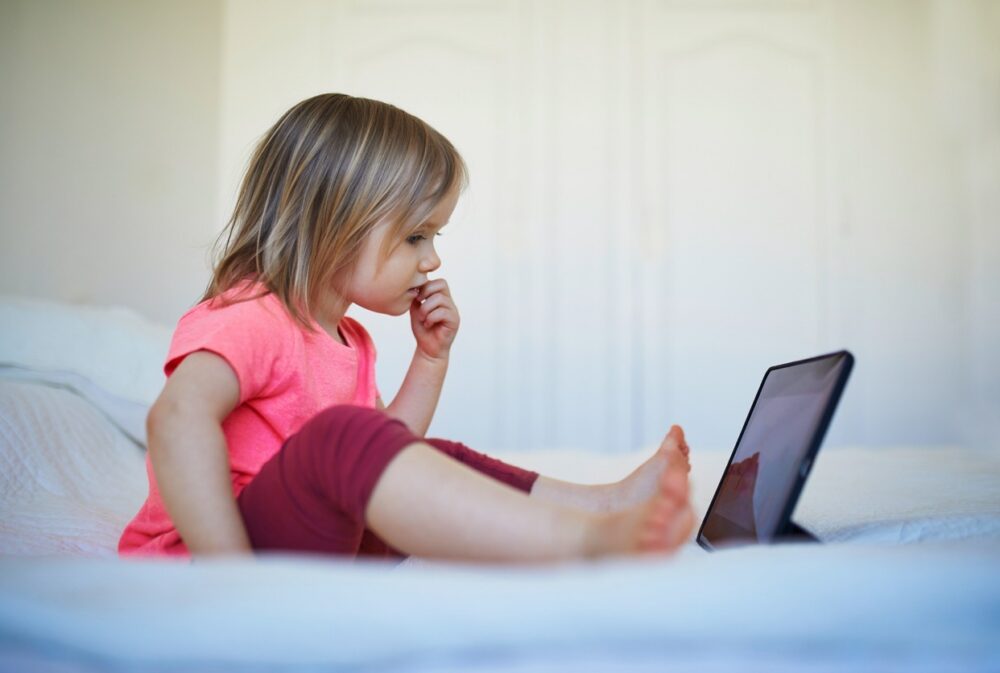
A small but important study finds that unsupervised, solitary screen time – on TV or handheld devices – may worsen behavioral and emotional challenges in young children who already struggle with language skills.
The findings, published last month [March 2026] in Research on Child and Adolescent Psychopathology, show that preschoolers and kindergarteners with poor communication skills and smaller active vocabularies developed more behavior problems over six months if they spent more time alone on screens. Boys spent more time alone on screens and showed more behavior problems than girls.
The effects were most evident among children averaging just 10 to 30 minutes of solitary screen use on televisions, phones or tablets per day across a week. More time alone on screens was also linked to more emotional problems later on. However, screen time did not consistently make emotional problems worse for kids who already had language difficulties.
Overall, the findings point to solitary screen use as a factor that may worsen developmental trajectories, likely by reducing opportunities for critical social interactions that support language and cognitive growth, emotional regulation, and relationships.
“Like other home environment risks, solitary screen time poses a unique peril to young children with heightened vulnerabilities,” said Molly Selover, lead author and an FAU doctoral student in psychology.
Excessive screen use by young children is widespread, and technology is designed to capture and profit from users’ attention. The World Health Organization, American Academy of Pediatrics, and American Psychological Association recommend no more than one hour per day for children ages 2 to 5, yet a global review found that two-thirds of households exceed this limit.
In the U.S., children in this age group spend more than two hours a day on screens during the week, according to a 2025 survey of about 1,500 parents of children age 8 or younger. By age 4, more than half (58%) of children have their own tablet.
Most recently, the social media company Meta and video streaming service YouTube were found guilty of harming a young user’s mental health in a case that accused them of creating digital products as addictive as cigarettes or online gambling.
Scientists have established that early language difficulties, often linked to less unstructured or language-rich home environments, forecast later socioemotional challenges. Previous research suggests language impairments during early childhood heighten the severity of behavior and emotional symptoms years later, contributing to problems such as academic struggles, depression, and substance abuse.
Oral language skills, which are tied to self-regulation and impulse control, are particularly important as a child’s social world expands. When children face difficulty communicating their needs, it can lead to frustration, sadness, or acting out. Cognitive development and self-worth may also be affected as children struggle to catch up with their peers.
At the same time, a growing body of research links screen use to emotional problems in children, possibly due to exposure to violent, confusing or scary content, insufficient sleep, or disrupted brain development. High exposure to electronic media during early childhood has also been associated with attention problems and changes in how different parts of the brain develop together.
Unsupervised screen time often involves entertainment content on platforms like YouTube that does little to promote linguistic, cognitive, or behavioral competence. It also often competes with, distracts from, and reduces higher quality interaction with adults.
Young children learn language best from the back-and-forth, in-person interactions, not passive screen use, research has shown. Dr. Brett Laursen, senior author and a professor of psychology in Florida Atlantic University’s Charles E. Schmidt College of Science, says the opportunity costs of solitary screen time — in other words, the loss of valuable ways of spending time — can be particularly steep for vulnerable youth.
Children who are overly attached to screens may:
- Miss chances to hone social skills or develop proficiency in activities that promote social interactions
- Be exposed to fast-paced, overstimulating content that models inappropriate behavior for their age, such as violence, swearing, sexual content, or bullying
- Develop decreased attention than can worsen the emotional, behavioral, and interpersonal problems of those with language difficulties
“Time spent alone with a screen is time that is not spent with friends and family members, time that is not spent sleeping, playing or engaged in physically robust activities. Our study adds to this list of concerns,” Laursen said. “Screens don’t demand compromise, sharing or dialogue – the exact skills that children with communication difficulties need to practice.”
The study followed 546 children ages 4 and 5, including 264 girls and 282 boys, attending two dozen childcare centers across Denmark. All families in Denmark receive strong state support for child development, providing a relatively high baseline of resources, the researchers say, which should have reduced risks linked to language-limited environments.
Teachers used an online questionnaire to rate behavioral and emotional problems at the beginning and end of the school year. They also used standardized assessments to evaluate child language abilities, including communication skills and the words the children could actively use when speaking or writing (productive vocabulary).
Meanwhile, parents reported the amount of time children spent alone using handheld devices or television. The study also measured how many books were in the home as a rough indicator of the home learning environment.
Very little of the teacher-reported data (about 1%) was missing, but a larger share of the parent-reported data (about 31.5%) was missing. The researchers found no meaningful differences between children with and without missing data.
This study has limitations. It didn’t assess the type of content viewed, and parent reports may underestimate screen use. Because the research was conducted in Denmark, the findings may be even stronger in lower-resource settings where support for children with language or socioemotional difficulties is more limited, the researchers say.
“Young children with limited language skills are already at risk for social and emotional challenges,” said Selover. “There is little reason to expect that screens help children overcome the adaptive challenges posed by oral language problems and many reasons to suspect that they make matters worse.”
Reference
Selover M, Leggett-James MP, Højen A, Bleses D, Laursen B. Solitary screen time exacerbates later socioemotional problems in young children with oral language difficulties. Research on Child and Adolescent Psychopathology. 2026;54(2). doi:10.1007/s10802-025-01409-8