









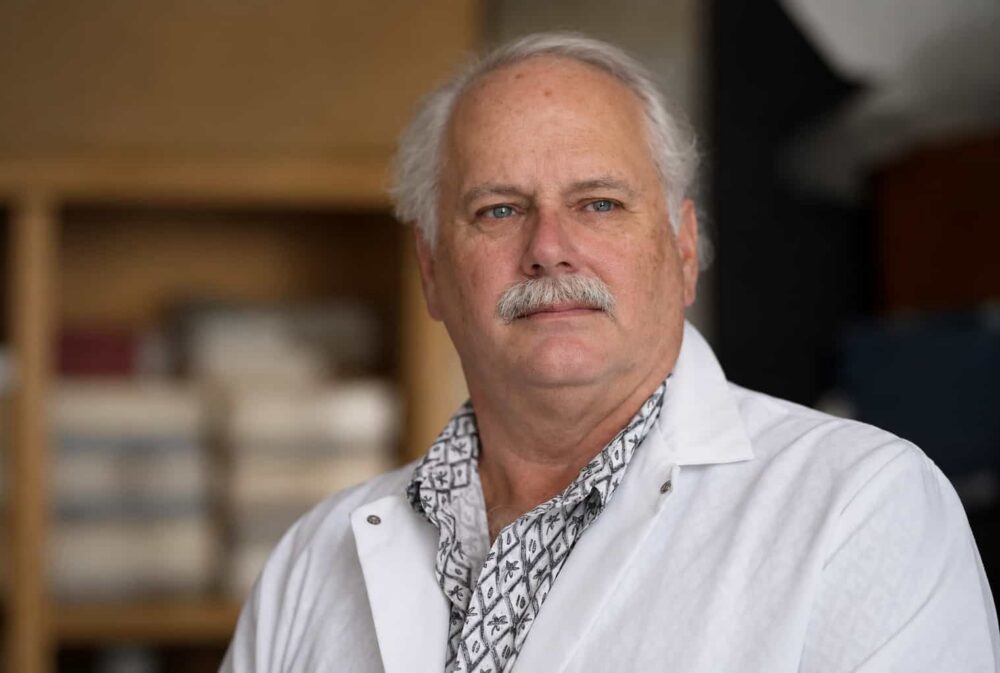
In early February 2020, as scientists and U.S. intelligence officials scrambled to understand the origins of the emerging coronavirus, prominent virologist Ralph Baric was asked to make a public statement knocking down claims that a chimeric coronavirus created in his University of North Carolina laboratory using genetic material supplied by a Wuhan scientist was the virus causing the outbreak.
Baric thought the scientific answer was straightforward. The viruses differed by more than 5,000 nucleotides, the individual building blocks that make up a viral sequence, he wrote, adding the chimeric viruses created at his laboratory “were never sent to china.”
But what appeared to worry him more was how his statement might be used.
In a Feb. 6 email to a group of scientists who advise U.S. intelligence agencies, Baric said the requested statement could help rebut claims circulating on Chinese social media. But, he warned, it also could be used for “nefarious purposes to shift blame.”
“I have received a few concerning, if not threatening, emails,” Baric wrote. He said he had informed his university and advised the group he “believe[d] that you should be informed as well.”
The email, which was among records recently obtained by U.S. Right To Know, through an ongoing Freedom of Information Act lawsuit against the Office of the Director of National Intelligence, does not identify who asked Baric to make the statement, and it does not say whose blame he feared might be shifted, or onto whom.
But it captures an early moment in the COVID-19 origins debate when a key U.S. coronavirus researcher who had collaborated with Wuhan Institute of Virology scientist Zhengli Shi was concerned about how a rebuttal might be used.
A request for a public statement
Baric had collaborated for years with scientists studying SARS-related bat coronaviruses, including Shi.
In 2015, Baric and Shi co-authored a Nature Medicine paper describing experiments involving a chimeric SARS-like coronavirus. Researchers at UNC constructed the virus using the backbone of a mouse-adapted SARS coronavirus and the spike protein encoded by SHC014, a SARS-like bat coronavirus sequence supplied by Shi’s group.
The resulting virus replicated efficiently in primary human airway cells and produced pathology in mice, findings that later made the study a recurring subject of debate over the risks of coronavirus research.
By early February 2020, claims were circulating that the virus created in the 2015 study was connected to the emerging outbreak in Wuhan.
Baric’s Feb. 6 email suggests that someone had asked him to make a public statement rebutting that allegation.
The identity of the person or organization that asked Baric to make the statement is redacted in the email released to U.S. Right To Know. Baric’s name is also redacted, but he is identifiable from the context of the production, which came through ongoing litigation in response to a FOIA request for Baric’s communications with the Biological Sciences Experts Group (BSEG), and from overlapping public records that place him in the exchange.
Baric laid out what he considered the key scientific facts to reject the allegation, citing key differences between the SHC014 chimera and SARS-CoV-2, which was then still referred to as 2019 nCOV.
Baric later made the same basic argument publicly, emphasizing the large genetic differences separating the experimental virus from SARS-CoV-2 and saying that the chimeric viruses had not been sent to Wuhan.
What is new is the contemporaneous context surrounding the request that he say so publicly.
“Nefarious purposes to shift blame”
Baric told the intelligence advisers that he could see a legitimate reason for making the statement. Claims about his laboratory’s virus were circulating on Chinese social media, and a factual rebuttal could help counter them.
But he also saw another possibility.
The statement, Baric warned, might be used for “nefarious purposes to shift blame.”
The email does not explain what Baric meant by that phrase, say who might use the statement for such a purpose or specify where he feared blame might be shifted.
That ambiguity is important. The email does not support attributing the concern to China, the U.S. government, another laboratory or any particular person or institution.
Baric’s unease extended beyond the request itself.
“I have received a few concerning, if not threatening, emails,” he wrote.
“I have informed my university,” Baric added, “and believe that you should be informed as well.”
The warning came as Baric was already advising U.S. intelligence about the emerging coronavirus. A Jan. 28 presentation he provided included discussion of a possible accidental release from WIV, and later whistleblower testimony by CIA Operations Officer James Erdman III says a revised version provided two days later omitted the lab leak possibility from that discussion. The Jan. 28 presentation itself included an “Accidental Release” section discussing WIV’s work with SARS-related bat coronaviruses.
Other emails from Baric’s current and former colleagues provide a contemporaneous glimpse into his activities during the same period. U.S. Right To Know recently obtained the emails through a separate, ongoing FOIA lawsuit against the Department of Energy.
In an email on Feb. 7, UNC coronavirus researcher Timothy Sheahan described the atmosphere surrounding Baric as “survival mode,” writing that he was “on the phone with all these big people” and “has to meet with Fauci next week about this.” That meeting took place Feb. 11, and another virologist later wrote that Baric had told him he sat in Fauci’s office “talking about the outbreak and chimeras.” Former Baric researcher Amy Sims later responded to Sheahan that she saw that Baric had given “at least two presentations on campus and one at his secret agent meeting as well” – an apparent reference to his briefing of the Biological Science Experts Group that helped to advise ODNI.
That means the Feb. 6 email came during a period when Baric was simultaneously dealing with public allegations about his own research and advising U.S. intelligence as officials investigated the emerging outbreak.
Another public statement, the same day
Baric’s warning also coincided with a separate effort to shape a public scientific response to claims about COVID-19’s origins.
On Feb. 6, Baric was involved in discussions with EcoHealth Alliance President Peter Daszak and other scientists about what eventually became a statement published in The Lancet condemning “conspiracy theories suggesting that COVID-19 does not have a natural origin.”
Those emails have been public for years after U.S. Right to Know obtained them through FOI requests.
That day, Daszak separately emailed Baric to say that he and Linfa Wang had concluded that Baric, Wang and Daszak should stay off the statement so it would have “some distance from us.”
“We’ll then put it out in a way that doesn’t link it back to our collaboration so we maximize an independent voice,” Daszak wrote.
Baric agreed.
“Otherwise it looks self-serving and we lose impact,” he replied.
Daszak ultimately did sign the statement, which was published in The Lancet on Feb. 19 with 27 signatories. Its authors said they “strongly condemn conspiracy theories suggesting that COVID-19 does not have a natural origin.”
The Feb. 6 email about the 2015 chimera was a separate exchange.
The available records do not show that Daszak asked Baric to issue the statement about the chimeric virus, that the two public-messaging efforts were coordinated, or even that the people requesting them were the same.
Baric was also consulted later that month on another scientific commentary rejecting claims that SARS-CoV-2 had been engineered in a lab. Emails previously obtained by U.S. Right To Know show that Baric and Shi had reviewed the manuscript before its publication in Emerging Microbes & Infections, and that at least some of their comments were incorporated into the paper. However, neither was acknowledged as a contributor.
During the process, the journal’s editor wrote to the authors, “We don’t want to appear that we are defending Ralph even though he did nothing wrong.” The commentary was published Feb. 26, 2020 under the title, “No credible evidence supporting claims of the laboratory engineering of SARS-Cov-2.”
The scientists who drafted the commentary also privately distinguished between laboratory engineering and the possibility of an accidental lab release. In a February 16 email, lead author Shan-Lu Liu wrote that “we cannot rule out the possibility” that the virus leaked from the lab, and proposed changing the commentary’s working title from “SARS-CoV-2: no evidence of a laboratory origin,” to language focused more narrowly on whether the virus had been engineered.
What was, and was not, sent to Wuhan
Baric’s statement that his lab’s chimeric viruses were “never sent to china” did not mean his laboratory had never provided research materials to the Wuhan Institute of Virology.
Four days after sending his warning to the intelligence advisers, Baric contacted Sims, who had only recently left his lab for a job at the DOE’s Pacific Northwest National Lab, with a question about an earlier transfer to Wuhan, DOE emails show.
“It’s a mad house here. I need your memory,” Baric wrote on Feb. 10. “Do you have any recollection as to when we sent the ACE2 mice to China, Institute of Virology in wuhan?”
Sims replied that she was “90% sure we did indeed send the mice to China.”
“It took forever to get everything approved,” she wrote, offering to search her old emails for more details.
Although that acknowledged transfer does not contradict Baric’s Feb. 6 statement that he hadn’t sent the chimeric viruses to China that were studied in the 2015 collaboration with Wuhan researchers, the exchange illustrates that Baric appeared to be attempting to piece together the timing of research materials he had transferred to the Wuhan lab in the days after he briefed intelligence officials about the pandemic’s possible origin.
The University of North Carolina has since withheld thousands of pages of records about Baric’s laboratory research in response to public records requests, including its formal transfer agreements with the WIV, known as Material Transfer Agreements or MTAs, which contain details about research materials Baric’s lab shared with the Wuhan lab. Legal efforts to obtain such records have been stymied.
Baric, 72, retired from UNC in June after four decades at the university. His departure came weeks after the Department of Health and Human Services suspended him from receiving further federal research funding and launched proceedings that could debar him from federal funding for at least three years, possibly longer.
That action involves separate, federally funded virus research conducted years before the pandemic. HHS has accused Baric of a “pattern of deception” in communications with the National Institute of Allergy and Infectious Diseases about whether his research involved “gain-of-function” experiments to make viruses become more infectious and potentially dangerous to humans. Baric has vigorously denied wrongdoing, calling the allegations “bullshit” and telling Science Magazine that he planned to appeal the proposed debarment.