









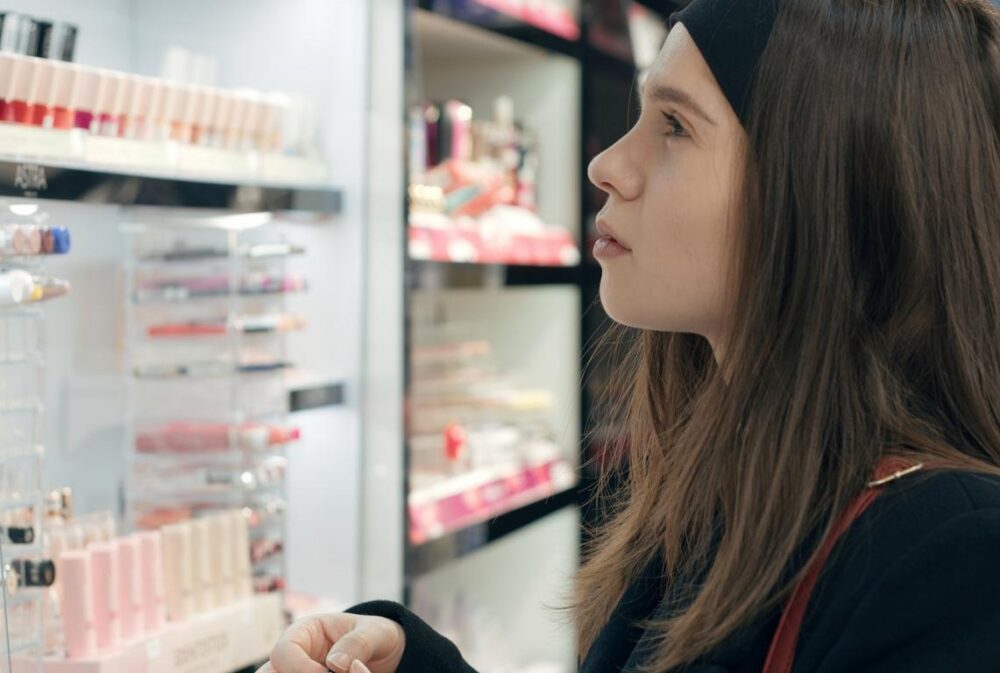
Lindsey Deng steers a red shopping cart into the travel aisle of her local Target, filled with miniature bottles of shampoos, lotions, and cosmetics. Packing for a trip to Texas, the 24-year-old Northwestern University student scans shelves for TSA-friendly versions of products recommended by social media influencers.
“I only look at the ingredients for my own skin type. As long as a product is on the market and from a big corporation or reliable brand, I feel like it shouldn’t contain too much [to be worried about],” Deng said. “I trust the manufacturers.”
But a small study shows that assumption may not hold. Routine decisions about everything from mascara to moisturizer matter when it comes to shaping your chemical exposure and health risks, the researchers suggest.
On average, women use 13 personal care products a day, containing more than 100 unique ingredients, and men use about 11. Roughly 1 in 10 adults uses more than 25 products daily. Late last year, the FDA reported that more than 1,700 cosmetic products contain PFAS — so-called “forever chemicals” tied to serious health risks including cancer, birth defects and liver disease.
The findings, published in the May issue of Environment International, indicate that switching from conventional personal care products to nontoxic alternatives can rapidly and significantly reduce exposure to harmful chemicals. Even a few changes in only a few days can lower body levels of substances linked to hormone disruption, cancer, developmental problems, and reproductive toxicity, the study shows.
Significant declines in BPA, parabens, and pthlalates
The researchers found traces of toxins in most participants’ urine. Many of these chemicals, often added by manufacturers as preservatives, stabilizers, and antibacterial agents, left the body quickly when use declined.
The observed reductions could result in meaningful health benefits, the researchers say. Over five days, they observed a marked drop in health-harming chemicals, including bisphenol A (BPA), along with decreases in parabens and phthalates.
Specifically:
- Bisphenol A (BPA) levels dropped by roughly 39%.
- Parabens decreased by 30%.
- Phthalates decreased by 22%.
“The results of this new study are very exciting as they offer further evidence that consumers can rapidly reduce their burden of several known hormone-disrupting chemicals by using fewer, safer personal care products,” said Dr. Emily S. Barrett, a Rutgers School of Public Health epidemiologist and deputy director of the Rutgers Center for Environmental Exposures and Disease.
She added, “Ideally, tighter regulations would prevent potentially harmful chemicals from being included in product formulations. However, short of that, this study should empower consumers to feel that they can make smart choices to reduce their own exposure.”
A similar study, published last year, showed 70 Black and Latina women in South Los Angeles lowered their exposures to several chemicals linked to health risks by choosing nontoxic personal care products. For instance, Black women who avoided fragranced products had about three times lower levels of monoethyl phthalate in urinary samples than those who rarely considered product ingredients.
Similarly, Latina women who said they avoided products containing oxybenzone had lower average levels of the endocrine disruptor in their bodies than those who did not. Few participants overall, however, were knowledgeable about potentially toxic chemicals themselves.
Nor should they have to be, especially in marginalized communities, the study’s authors said at the time.
“It is great that shopping choices can make a difference and lower exposures to some harmful chemicals. However, the burden to protect oneself from risky products should not be on the consumer,” said co-author Dr. Lariah Edwards, an associate research scientist at the Columbia Mailman School of Public Health.
Urine testing reveals rapid drop in toxic chemicals
The study followed 103 female university students ages 18 to 30 in Grenoble, France. Participants reduced or stopped using their usual lotions, cosmetics, perfumes and hair products for five days.
Instead, they used non-toxic study-provided alternatives. These included soap, shampoo, deodorant, toothpaste, sunscreen, lip balm, jojoba oil and hydroalcoholic gel. The researchers avoided plastic packaging when possible to limit contamination.
Participants recorded product use and household exposures. They also recorded consumption of food or drinks stored in plastic or cans using a mobile app. Other exposure sources, including diet and household products, remained stable.
The researchers collected 24-hour urine samples before and after the intervention. They then analyzed them for 11 phenols (such as bisphenols and triclosan) and 16 phthalates. They also looked for two glycol ethers, solvents used in liquid soaps and cosmetics and linked to reproductive health harms.
The analysis showed consistent declines across multiple toxic compounds used in personal care products:
- Monoethyl phthalate (MEP), a byproduct of diethyl phthalate used in fragrances, decreased by about 22%, consistent with prior U.S. adolescent studies.
- Methylparaben decreased by about 30%.
- Phenoxyacetic acid decreased by 64%, and propylparaben appeared less frequently.
Reducing BPA exposure in pregnancy
A separate analysis linked lower BPA exposure during pregnancy to fewer childhood respiratory conditions and modest cognitive gains. The researchers modeled how switching products could potentially affect pregnant women and the future health of their children. They say they focused only on bisphenol A because of stronger evidence linking it to adverse child health outcomes.
Based on epidemiological data and biomarker comparisons, the model indicated that replacing toxic personal care products with non-toxic products could prevent about 4% of asthma and 4.4% of wheezing cases in children. It also projected a small prevention of IQ loss in children, about 0.4 points, and a slight reduction in BMI increases of 0.04 points.
Individual effects were modest but could accumulate across populations, the researchers say.
“Health impact assessment was not possible for other chemicals, due to the absence of estimated probabilities of causation or lack of adequate dose–response functions,” they wrote. “However, reductions in these chemicals are also likely beneficial, as several studies have linked them to adverse health effects – for example, phenoxyacetic acid has been associated with impaired neurodevelopment at exposure levels similar to those found in our study.”
Changing shampoos isn’t enough to safeguard health
The study notes several limitations. The sample included only young adult women from one location, and participants acted as their own controls. Diet, exercise or other behaviors may have affected results, despite instructions to maintain usual habits.
The short intervention limits conclusions about long-term exposure changes. The researchers also selected alternative products based on ingredient lists without laboratory testing, so possible contamination cannot be ruled out.
The researchers pointed to product formulation and packaging as ongoing exposure sources. Switching to safer alternatives can rapidly lower the body’s chemical burden, they say, but broader regulation is needed to protect public health.
“While average decreases in urinary concentrations were substantial, several chemicals remained detected after the intervention phase,” they wrote. “Individual changes in PCPs use can decrease exposure to these chemicals, but regulatory actions would probably be more efficient and fairer.”
To reduce your exposure to toxic chemicals, choose fragrance-free personal care products and cosmetics. Avoid antibacterial soaps and toothpaste. Also be cautious with long-lasting, waterproof make-up that often contains PFAS, and imported cosmetics, which may contain lead or other heavy metals.
Reference
Jovanovic N, Bright F, Thomsen C, et al. Levers to decrease exposure to harmful chemicals: the case of personal care products and cosmetics. Environment International. 2026;211:110243. doi:10.1016/j.envint.2026.110243