









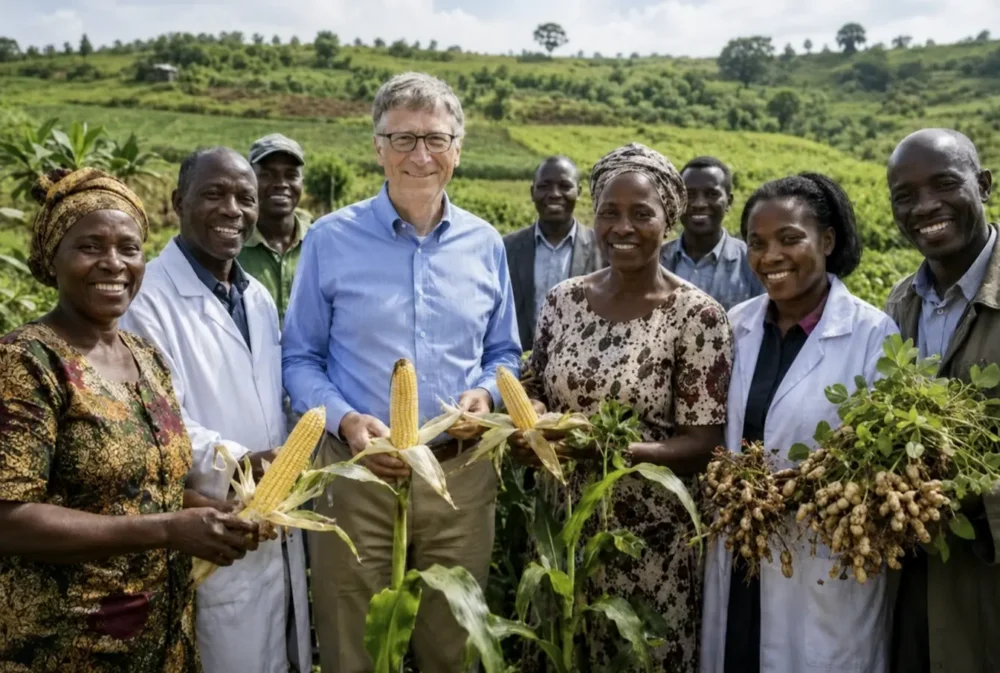
Twenty years ago, the Gates and Rockefeller foundations launched the Alliance for a Green Revolution in Africa (AGRA), promising agricultural transformation from improved seeds, synthetic fertilizers, mechanization, and commercial markets.
These interventions, they said, would double crop yields and farmer incomes, and cut food insecurity in half in one of the world’s hungriest regions. To achieve these goals, they urged African governments to subsidize inputs, reform policies and court private investments.
Bill Gates became one of the idea’s leading promoters. He argued that the technologies behind the original Green Revolution – particularly “magic seeds” and the “magical innovation” of fertilizer – could lift millions of people out of poverty.
He described the approach as “creative capitalism”: using business incentives, corporate investment, and government support to create new markets that raise farmer incomes and thereby reduce hunger.
Africa could avoid many of the problems of the earlier Green Revolution in Asia by pursuing what Gates called a “greener revolution,” one “guided by small-holder farmers, adapted to local circumstances, and sustainable for the economy and the environment.”
Many African groups disagreed from the start, arguing that agroecological approaches would reduce hunger more by rebuilding soils, cutting farmers’ dependence on expensive inputs, diversifying crops, and making farms more resilient to climate and economic shocks.
What does AGRA’s record show?
Now, nearly 20 years of data are in, and AGRA’s results fall far short of its promises. They raise fundamental questions about AGRA, the Gates Foundation and their influence on African governments and institutions.
The AGRA effort drew more than $1.5 billion in donations (two-thirds from the Gates Foundation), as African governments spent an estimated $1 billion a year in subsidies for fertilizer and other inputs in AGRA’s target countries.
“The Green Revolution has failed Africa,” the Alliance for Food Sovereignty in Africa said in a new report. “Twenty years is long enough to judge the Green Revolution model by its results. The evidence does not justify another decade of the same priorities at greater scale.”
The report is based on an August 2026 working paper by Timothy A. Wise, senior research fellow at Tufts Global Development and Environment Institute, that reviews 18 years of United Nations and World Bank data from 2006 through 2024.
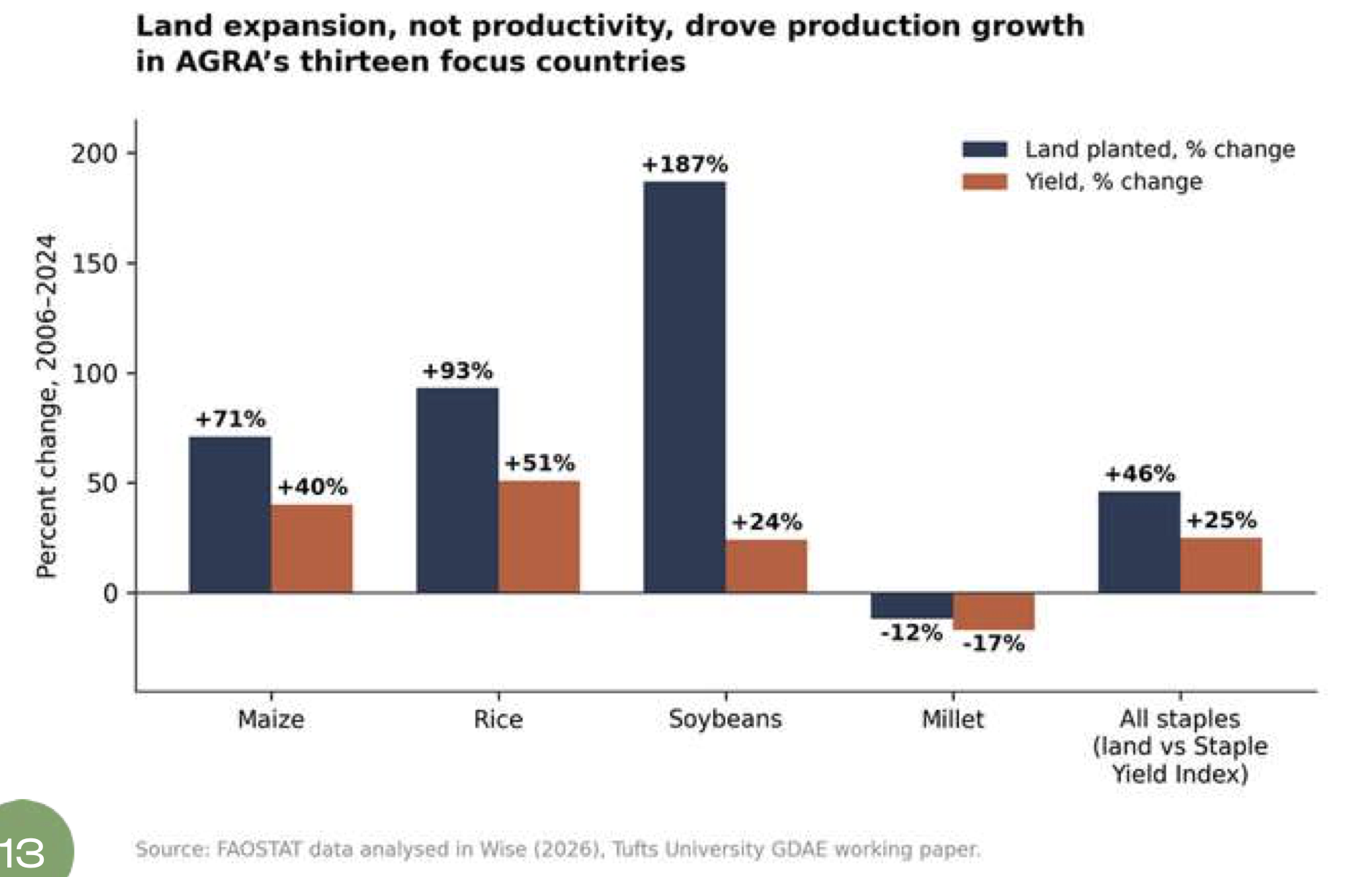
The analysis finds that across the 13 countries that were the focus of the AGRA effort, fertilizer use more than doubled and cultivated land expanded by 46% – yet yields for major staple foods increased by only 25%, far less than AGRA’s promised doubling.
Staple-crop yield growth was 1.2%, slightly slower than in the 12 years prior to AGRA, which saw 1.3% yield growth. It slowed even further in the most recent six years, to roughly 0.4% a year.
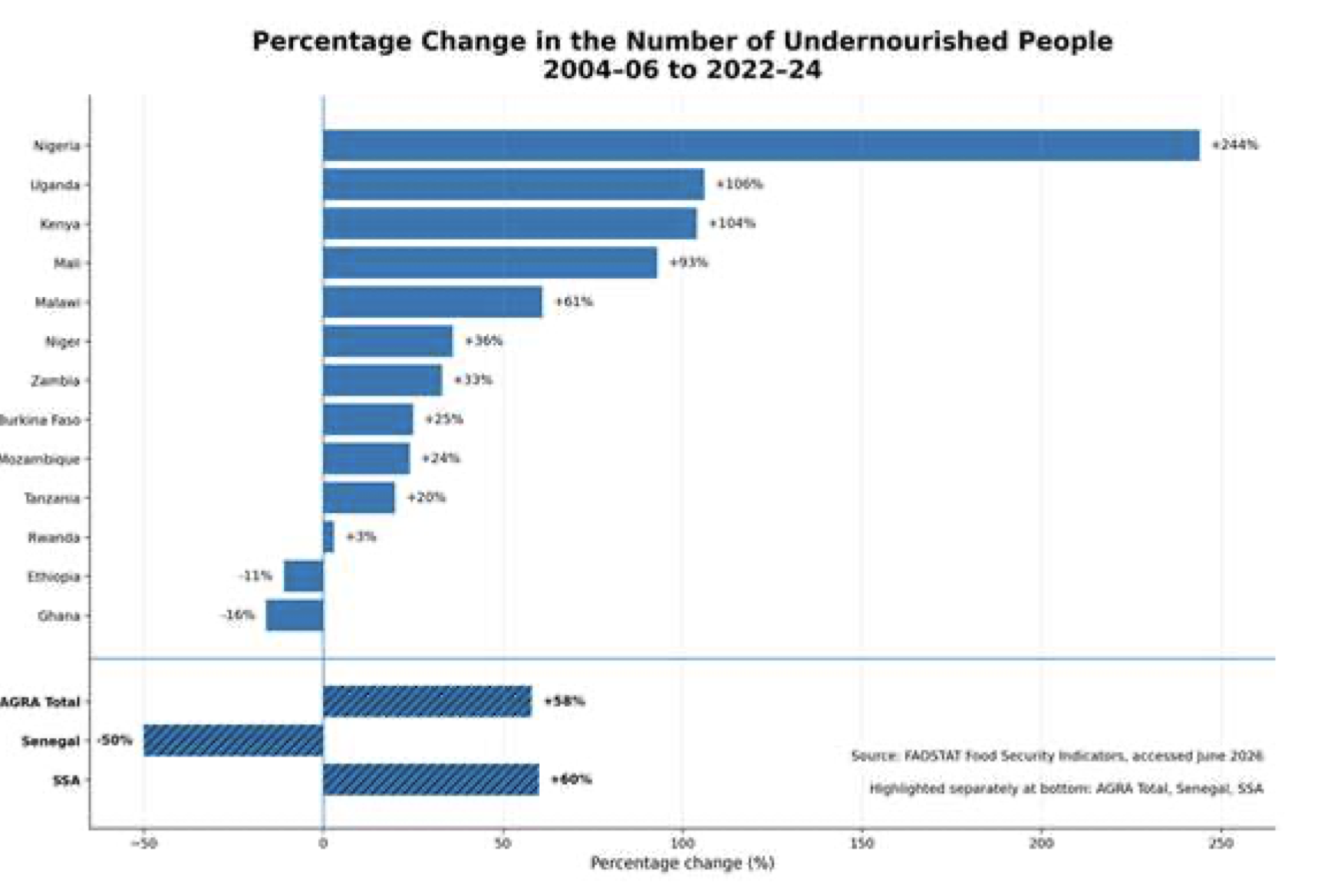
Most troubling, the number of chronically undernourished people increased by an average of 58% across AGRA countries.
The Gates Foundation did not respond to requests for comment on the Tufts report. AGRA spokesperson Humphrey Chola told U.S. Right to Know that the report and underlying data “raise important issues about AGRA’s 20-year record, accountability, and future direction.”
AGRA’s own 20-year review concedes that hunger has risen, farmers are not yet prospering, and the gains of the past two decades “have not added up to transformation.” But the executive summary of the AGRA review, released August 31, says the past 20 years have “brought real gains” to Africa’s agrifood systems, and pitches for more investments in the same market-based logic.
“Transformation is about more than just producing more food. It is the shift from low-productivity farming methods towards a productive market-oriented agrifood economy,” the executive summary states. (The full report is “coming soon,” AGRA said.)
Losing ground on crop diversity
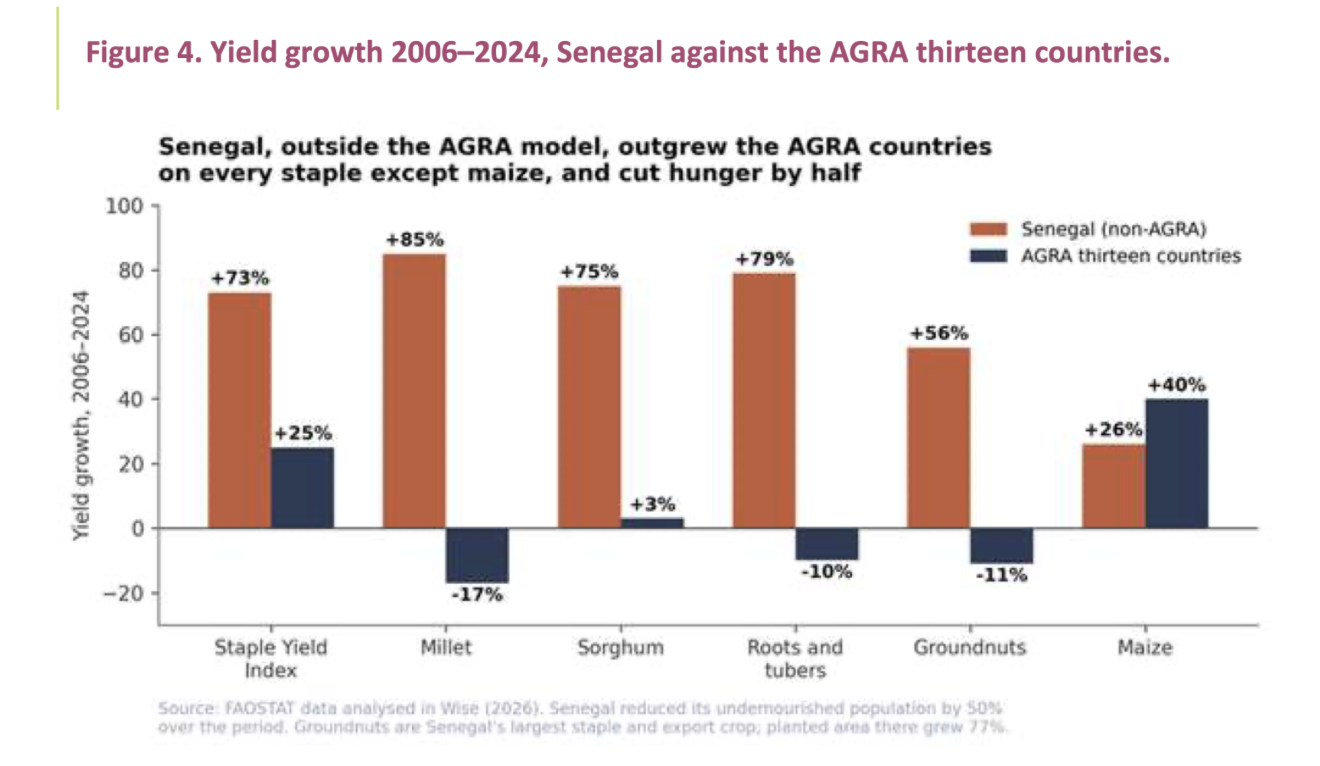
As AGRA and government subsidies steered farmers toward commercially oriented crops such as maize and rice, indigenous crops such as nutrient-dense millet and sorghum lost ground.
The trade-off is especially consequential as the climate warms: many traditional crops are more tolerant of drought, heat and poor soils, even as they provide more diverse diets.
In Zambia – where the number of undernourished people rose 33% – land devoted to nutrient-dense millet fell 42% and sorghum production declined 62% since 2006. Fertilizer use there increased 155%, reaching the highest levels among AGRA countries, yet maize yields rose just 14%.
Senegal – which was not an AGRA country – offers a notable contrast. The country supported a more diverse array of crops and a less fertilizer-intensive development strategy. Senegal cut the number of undernourished people in half, while its staple-yield index rose 73%.
AGRA perspectives
In its 20-year review, AGRA cites a larger productivity gain, about a 40% increase in cereal yields, though it is measuring a narrower set of crops. Tuft’s 25% figure uses a broader index of staple foods grown across AGRA’s focus countries, including roots and tubers as well as grains, to capture what happened across the food crops people depend on.
“Africa’s agricultural GDP accelerated from about 2.4% in prior decades to over 4% after 2000, while farm output roughly doubled in real terms after 2005,” states the AGRA report summary, citing a 2021 book chapter. Those measures show Africa’s agricultural sector producing more economic value, but not how those gains were distributed or whether they translated to better incomes for farmers.
In its press release, AGRA claims a doubling of farmer incomes, but provided no methodology to back that up. The executive summary of the report does not make that claim and the full report was not published as this article went to press. The claim runs counter to household surveys showing persistently high rural poverty.
Wise called the claim “wildly misleading,” and said AGRA “seems to be misinterpreting the data showing a rise in total farm revenues, which exclude farmers’ rising costs, and fail to account for the prevalence of farmers with small landholdings and limited resources.”
Major global shocks are a factor
“There has been progress, there has – not enough but it’s an improvement,” said Andrew Cox, AGRA’s director of strategy, monitoring, evaluation and learning. “Obviously the challenges of transforming agriculture is a major difficulty. If it was easy it would have happened already.”
AGRA leaders stressed that their group is only one actor in a complex food system shaped by governments, markets, donors, farmers and global events. The “great tragedy,” Cox said, “is that malnutrition has increased in Africa in recent years.” He cited major shocks including political conflicts, the COVID-19 pandemic, and rising food and fertilizer prices.
He also acknowledged that some production growth has come from expanding cropland rather than raising yields on existing farmland – the “sustainable intensification” AGRA has long sought to promote. Cox called that expansion “a major environmental hazard” that AGRA and its partners have been trying to address for the past 20 years.
Recent peer-reviewed research helps explain why. Expanding cropland can drive deforestation and habitat loss, reduce biodiversity and release large amounts of carbon as forests, grasslands and other ecosystems are converted to farms. Those risks are especially acute in tropical Africa, where many areas suitable for agricultural expansion are also rich in biodiversity and carbon.
Data undercut the Green Revolution’s theory of change
The data call into question a central premise of the Green Revolution’s model: that boosting agricultural productivity is a reliable path to reducing hunger.
Malawi, one of AGRA’s strongest performers, recorded a 78% increase in staple-crop yields between 2006 and 2024, yet the number of chronically undernourished people there rose 61%.
Population growth accounts for part of the increase in hunger, but the stark divergence underscores a larger point that critics of the Green Revolution have raised from the start: producing more food does not necessarily translate into less hunger when people cannot afford or access it.
In Kenya, home to AGRA’s headquarters, farmers describe a punishing cycle: rising spending on fertilizer and commercial seeds even as heavy fertilizer use contributes to soil acidification. Wise’s analysis finds that staple crop yields there have fallen 8% since AGRA began while the number of undernourished Kenyans has more than doubled.
Time for a new approach?
The data and new analyses reinforce longstanding criticism that Africa’s input-intensive Green Revolution model is poorly suited to the region’s ecological and economic realities.
“AGRA didn’t fail because of want of funding. It is a well-funded demonstration that hunger was never a shortage of technology. It is a shortage of power, and bags of hybrid seed don’t redistribute power: they concentrate it,” said Raj Patel, research professor at the University of Texas at Austin and the incoming co-chair of the International Panel of Experts on Sustainable Food Systems.
Both AGRA and its forum rebranded in 2022 to retire the Green Revolution label. But its central development model remains unchanged: to transform African agriculture through commercial inputs and technologies, private-sector value chains, policy reform and investment in agribusiness.
“AGRA…is a well-funded demonstration that hunger was never a shortage of technology. It is a shortage of power, and bags of hybrid seed don’t redistribute power: they concentrate it.” Raj Patel, IPES co-chair
But as the AGRA-sponsored Africa Food Systems Forum convenes this week in Kigali, market-oriented approaches to solving Africa’s food crisis are front and center, as AGRA continues its 2026 “reflection and celebration tour,” pitching African agriculture as “the next big investment opportunity.”
“All the investment that went into the agrichemicals and improved varieties didn’t work,” said Million Belay, general coordinator of the Alliance for Food Sovereignty in Africa. “But this model is expanding despite the evidence.”
Gates’ vision for transforming African agriculture became, over time, more than just a philanthropic experiment. It became the dominant model for agricultural development, shaping government policies and attracting billions of dollars from national governments, foreign aid agencies and multilateral institutions.
AGRA played a key role, Belay said, in the African Union’s latest 10-year agricultural plan, which seeks to mobilize $100 billion and sharply increase food production through 2035. Although the African Union found that no country was on track to meet the food and agriculture targets set under the previous plan, the new strategy continues to emphasize the same productivity- and market-driven approach instead of supporting agroecological methods.
“We should not spend the next decade rediscovering what the last twenty years have already taught us,” the food sovereignty alliance argues in its report. “Public investment should support healthy soils, farmer-managed seed systems, diversified production, farmer-led extension, local processing and territorial markets.”
Where is the accountability for philanthropy gone wrong?
For years, Africa-based groups have criticized AGRA and called on the Gates Foundation to scale up research and support for agroecological food systems.
In 2022, African faith leaders asked the Gates Foundation to stop pushing the Green Revolution model they said is “deepening the humanitarian crisis.” In 2024, they demanded reparations from the foundation “for the ecological and social damage caused.” The Gates Foundation has offered no public response.
The AFSA coalition has written written to the Gates Foundation and other AGRA donors, raising concerns about AGRA’s influence over African food systems and African government policies. When they finally did meet, Gates Foundation representatives “came to convince us of the value of their approach instead of listening to us and looking at the data and changing pathways,” Belay said.
“When firms get things wrong, markets will discipline them. And when governments get things wrong, voters will kick them out. Philanthropy doesn’t have any of those pressures,” said Raj Patel, the incoming IPES co-chair.