









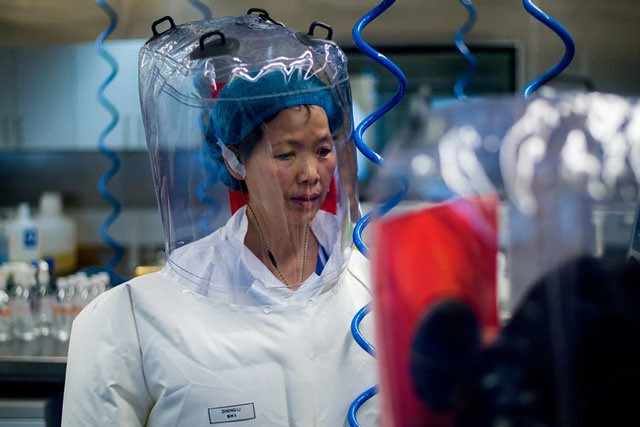
In April 2018, Chinese virologist Zhengli Shi emailed a trusted American collaborator with what she framed as “a favor.” At the time, her team at the Wuhan Institute of Virology were testing whether newly discovered bat coronaviruses could infect other animals.
Another U.S.-based researcher, Shi wrote, was preparing to send monoclonal antibodies she needed “to test the efficiency against SARS-related CoV infection in animal models.”
But instead of shipping them, Shi suggested an alternative: the antibodies could be “brought back to China by Chuming” – a lab researcher. Monoclonal antibodies are not infectious agents, but international transfers of research materials usually require formal procedures.
The exchange appears in a tranche of more than 1,200 pages of emails and research records released by the University of Minnesota in response to a public records request by U.S. Right To Know. Many of the same documents had been released years earlier with redactions that have since been revised, newly revealing Shi’s suggestion that the antibodies be hand-carried rather than formally shipped.
The email was sent to Dr. Fang Li, a University of Minnesota virologist whose laboratory served as a hub for collaborations between U.S. and Chinese coronavirus researchers in the years before the COVID-19 pandemic. Shi’s reference to “Chuming” was to Chuming Luo, a postdoctoral researcher in Li’s lab and a former WIV scientist who appears throughout the correspondence helping coordinate experiments, share reagents and arrange research shipments.
“If you agree,” Shi wrote, “Chuming will be in charge of the following arrangement.”
Li declined.
“I don’t think it is a good idea to let Chuming take antibodies with him,” he replied. “Given the current tension between USA and China, this can put Chuming under risks. Please ask Lanying to ship the antibodies to you.”
The emails offer a rare glimpse behind-the-scenes into the informal exchanges of a close scientific collaboration between Chinese and American coronavirus researchers in the years before the COVID-19 pandemic.
Li’s lab frequently served as a facilitator in collaborations with some of the world’s leading coronavirus researchers, at times helping to share unpublished viral sequences and key reagents needed for high-risk experiments, the records show.
Two months before Shi asked Li for the favor, the Journal of Virology had agreed to publish a paper from Shi and Li’s teams about the discovery of a new bat coronavirus that used the same receptor to infect its hosts as the camel-derived Middle East Respiratory Syndrome (MERS), which has killed nearly 1,000 people since 2012. An editor suggested that, for the paper, more experiments should be conducted to test how well antibodies could block the new virus’s ability to infect cells.
Emails about the paper indicate that Shi’s lab lacked the materials needed to perform the requested experiments.
Shi noted to Li and Luo that “we need to conduct additional experiments. I suppose your (sic) have MERS-CoV antibody and can do it easily.”
“Yes,” Li replied, “we have the antibodies and Chuming will start testing them.”
Shi’s later emails in April that contained her request for Luo to personally bring her antibodies were linked to a different paper on SARS research that she and Li were preparing at the time for the journal Nature Reviews Microbiology.
Neither Li nor Shi responded to emails seeking their comments for this story. Luo, whose most recent published paper lists him as affiliated with the School of Public Health at Sun Yat-sen University in Shenzhen, China, also did not respond to emails.
Shipping and transfer rules
Purified monoclonal antibodies themselves are not infectious agents and usually don’t fall under international transport rules and federal laws. But moving biomedical materials across borders is rarely as casual as slipping vials into a carry-on.
Dr. Stanley Perlman, a University of Iowa virologist who collaborates with Li on coronavirus research, said that monoclonal antibodies are innocuous, but can be very expensive to ship to Asia or Europe.
“As long as you declare things and keep them on ice or whatever, carrying them is fine,” he said. “I’ve thought about carrying things. I never do because it’s always too cumbersome. But I would certainly declare it if I ever did.”
Even when biological materials themselves are not classified as infectious substances, shipments that require dry ice are still subject to international dangerous-goods rules governing carbon dioxide, including packaging and labeling requirements. Universities also typically require formal documentation, such as material transfer agreements and export-compliance reviews, before research materials are sent to collaborators overseas.
Scientists who work in high-containment virology labs also typically operate under layers of institutional, federal and international oversight governing how biological materials are handled and transferred. In that context, a suggestion of moving research materials outside normal shipping channels may seem unusual — particularly from a senior researcher accustomed to operating within those rules.
The University of Minnesota did not respond to requests for comment about its transport requirements for monoclonal antibodies. Its website shows that the university’s research office requires a formal material transfer agreement, or MTA, when research materials are sent to “a foreign institution” or “intended for in vivo research.”
U.S. prosecutors have pursued criminal cases against biomedical researchers tied to undeclared transport of research materials through airports, particularly when it involves travel to China.
In one high-profile case, a Chinese cancer researcher at Beth Israel Deaconess Medical Center was arrested at Boston Logan International Airport in 2019 after authorities found 19 vials of biomedical samples concealed in a sock in his luggage as he prepared to fly to China. Federal prosecutors said he had taken the materials from a Harvard-affiliated lab without authorization and attempted to carry them out of the country without formal permission from the institution. He later pleaded guilty to making false statements to federal agents, according to a Department of Justice press release.
The case illustrates how seriously authorities treat the unauthorized transport of research materials across borders. Viewed alongside the regulatory framework governing research-material transfers, the email exchange suggests that Shi — a focal point for lab-leak proponents because of WIV’s extensive coronavirus collection and manipulation work — was considering moving the antibodies outside normal shipping channels at a time when scrutiny of U.S.-China scientific ties was intensifying.
The origin of the COVID pandemic remains unknown. Shi has repeatedly denied that SARS-CoV-2 was engineered or released from her lab. Many other scientists also argue the pandemic virus can be explained by natural evolution.
The newly unredacted tranche of Li’s emails that contains Shi’s request for the antibody transport favor was also recently “produced to a congressional requester,” a public records officer for the university said in a written message.
“Due to the passage of time and other factors, such as research publication, redactions were revised,” the message added.
Lewis Kamb is an investigative reporter at U.S. Right to Know. He was the first national FOIA Reporter for NBC News and spent nearly a decade reporting for the Seattle Times, where he was part of the reporting team awarded the Pulitzer Prize for exposing the failures behind the Boeing 737 MAX crashes.