


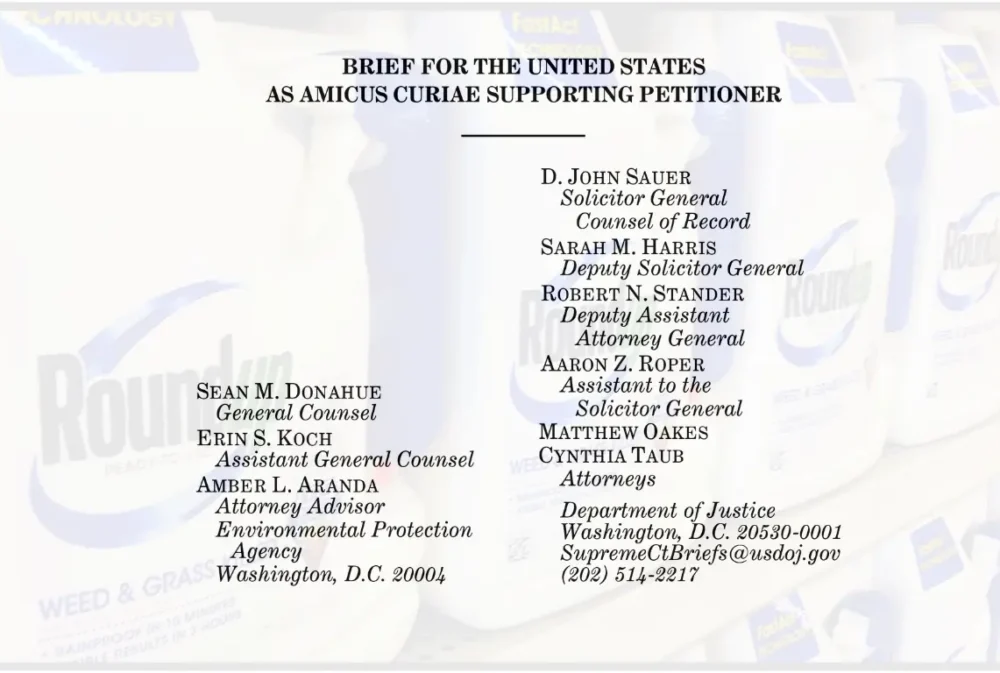
The Trump administration yesterday handed Bayer another win, urging the Supreme Court in a new brief to side with the German pesticide company in a high-stakes legal case that could wipe out thousands of cancer lawsuits and potentially billions of dollars in liability tied to glyphosate-based Roundup weed killer.
Three out of nine U.S. officials who signed the brief previously worked for law firms that have represented Bayer, raising questions about whether the Trump administration is providing special favors and benefits to Bayer and siding with a foreign corporation against Americans with cancer.
The brief is the second Justice Department intervention in the case. In December, the DOJ asked the Court to review Bayer’s case. The court accepted the case in January and oral arguments are scheduled for April 27.
In the new filing, the Justice Department and Environmental Protection Agency urged the Court to rule in Bayer’s favor on the central legal issue: whether federal approval of a pesticide label under federal law preempts state failure-to-warn claims. If the Court accepts that argument, individuals would be barred from suing Bayer under state law for failing to warn that Roundup may cause cancer.
The salvo for Bayer is the latest in a series of favorable actions the Trump administration has provided to Bayer. On February 18, the White House invoked the Defense Production Act to guarantee supplies of glyphosate-based herbicides and elemental phosphorus, a raw element used in production of fertilizers, pesticides, herbicides, and a wide range of industrial and military chemicals. Regulators also reapproved dicamba, a Bayer herbicide twice blocked by federal courts, and cleared the way for new pesticides containing toxic, persistent PFAS “forever” chemicals.
We reviewed the company’s ties to the Trump administration and found numerous connections between Bayer’s lobby and legal firms and senior officials in decision-making positions affecting pesticides regulations, chemical safety, and how our nation’s food system is shaped. The new Supreme Court filing adds more Bayer ties.
Signers on the brief include Deputy Solicitor General Sarah M. Harris, who swung between roles at Trump’s Justice Departments and a law firm that represented Bayer in product liability cases. Harris was acting solicitor general from January to April 2025. Before that she was a partner at Williams & Connolly LLP, which represented Bayer in a nationwide class action involving allegations that Bayer’s neonicotinoid insecticides harmed honeybees.
The firm also played a role in crafting Bayer’s legal arguments for the case that is now before the Supreme Court. On its website, the firm lists among its representation experience: “Bayer in MDL and various state coordinated proceedings (comprising over 15,000 cases total),” and said it was “asked to be co-lead trial counsel in one of the two initial bellwether cases” to be tried in the Philadelphia Court of Common Pleas, referring to one of the early Roundup trial cases before the litigation was paused for mediation. Recent documents show the firm still representing Monsanto (now Bayer) in Roundup litigation as of 2025. The firm also represented Monsanto in a 2025 settlement to end claims from roughly 200 people who said they were harmed from PCB contamination at a Washington state school, and in the U.S. District Court in Delaware in a legal dispute with Corteva Agriscience over patent claims. In 2020, Williams & Connolly represented Bayer before the U.S. Court of Appeals for the Second Circuit in litigation arising from the Mirena intrauterine device multidistrict litigation in which thousands of plaintiffs alleged injuries from the device.
Harris worked at Williams & Connolly’s Supreme Court and Appellate practice, representing clients in appeals in the high court and federal and state appellate courts. Prior to that role she worked for the first Trump administration, as deputy assistant attorney general in the DOJ’s Office of Legal Counsel from 2017-2020.
Assistant to the U.S. Solicitor General, Aaron Z. Roper, also signed the DOJ/EPA brief for Bayer and also worked at Williams & Connolly LLP. He was an associate at the firm’s Supreme Court and Appellate practice prior to working at the DOJ.
The brief was also signed by Robert N. Stander, deputy assistant attorney general in the DOJ’s Environment and Natural Resources Division. He spent roughly a decade at Jones Day, a firm that represented Bayer in matters related to its acquisition of Monsanto.
____________
Sign up for our newsletter to receive breaking news from U.S. Right to Know.
____________
Case hinges on EPA pesticide reviews
The Justice Department argues in its latest brief that the Supreme Court should rule in Bayer’s favor because federal pesticide law (FIFRA) vests EPA with responsibility to determine what pesticide warnings are necessary to protect human health and the environment.
If EPA deems a pesticide to be safe, that is essentially the final word about product safety; in the case of glyphosate, state law requirements to warn consumers about cancer risk “second guess the judgements of EPA,” and should not be allowed, the brief argues. “EPA registration process hinges on a robust scientific review,” the brief claims.
But EPA pesticide approvals are laden with controversy – and the glyphosate review is a prime example. In 2022, a federal appeals court vacated parts of the EPA’s glyphosate approval, finding the agency failed to properly consider cancer risks, among other problems. The approval is under review but past reviews have relied heavily on industry science.
In December, the same week the Justice Department filed its first brief asking the Supreme Court to take Bayer’s case – and sent Bayer’s stock soaring – an academic journal retracted a key glyphosate study that informed regulatory approvals around the world, over evidence of Monsanto ghostwriting and other serious ethics violations.
The episode highlights the stakes of maintaining meaningful, independent safety assessments for chemicals. But EPA officials last year dismantled the research office that provided the scientific underpinning risk assessments – a change EPA employees said is likely to increase political interference in decisions about chemical safety. Meanwhile, Republicans in Congress are attempting to gut the nation’s toxics laws in ways that would limit the science used to determine health risks and give industry even more say over the chemical assessment process.
See our recent investigation into Bayer’s ties to top officials in the Trump administration. Our Bayer lobby tracker provides information about the 45 lobbyists registered to lobby for Bayer as of the fourth quarter of 2025, the 13 lobby firms retained by Bayer, and dozens of leadership personnel at those firms who worked for the previous or current Trump administration or Trump’s presidential campaigns.