










Neonicotinoids are the most widely used class of insecticides in the world. They are often used as seed coatings on crops such as corn and soybeans, as well as on turf, ornamental plants, and pets as flea and tick treatments.
A growing body of scientific evidence raises concerns about the human health risks of neonicotinoid exposure. Studies in animals and humans link neonicotinoid exposure to neurotoxicity and reproductive toxicity. Some studies also report ties to breast and liver cancer, and type 1 diabetes.
Human exposure to neonicotinoids is widespread and begins before birth. Neonics are commonly detected in food, drinking water, and household dust. A study of American women found neonicotinoids or their metabolites in more than 95% of pregnant women tested. A 2025 review of evidence reports that neonicotinoids or their metabolites are routinely found in urine, breast milk, placental tissues, and infant cord blood. Children may have higher exposures and they are especially vulnerable to toxic exposures during early critical periods of brain development.
In addition, extensive research shows that neonicotinoids can harm bees and other beneficial insects, particularly through chronic and sublethal effects.
In the European Union, several neonicotinoids have been banned or severely restricted due to confirmed risks to bees. Their use remains common in the United States and elsewhere.
What are neonicotinoids?
Neonicotinoids are part of a family of synthetic chemicals structurally similar to the addictive tobacco alkaloid nicotine. Frequently used neonicotinoids include acetamiprid, clothianidin, dinotefuran, imidacloprid, and thiamethoxam. Imidacloprid, the first neonicotinoid to be commercialized, entered markets in the early 1990s.
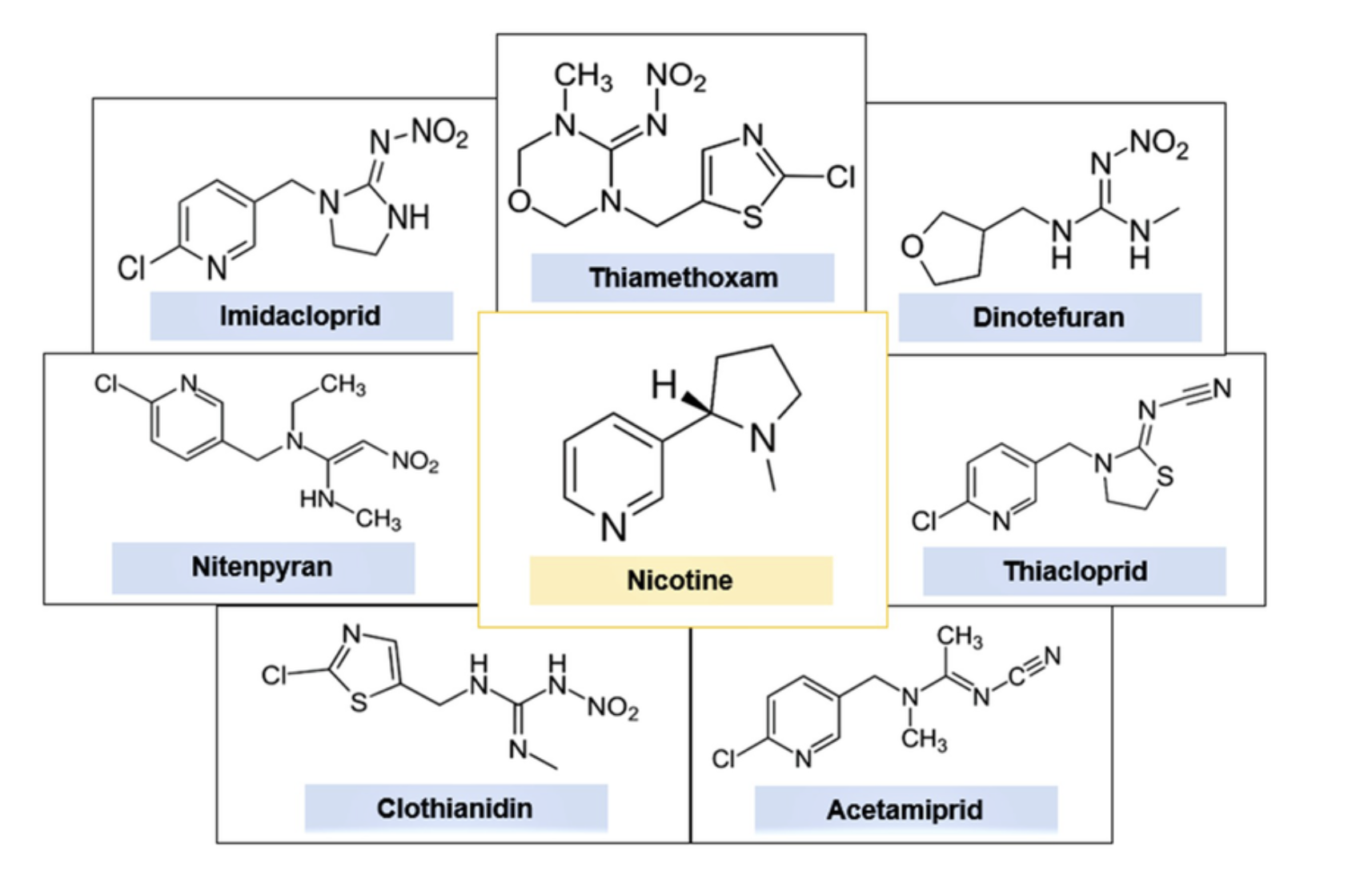
Chemical structures of nicotine and the neonicotinoid insecticides. Image from International Journal of Molecular Sciences.
Neonicotinoids are systemic insecticides. After plants absorb them, the chemicals can travel throughout plant tissues, including leaves, roots, stems, pollen, and nectar. Some neonicotinoids are highly persistent; they can move through waterways, accumulate with repeated use, and remain in soil for months or years.
The chemicals kill insects by binding to nicotinic acetylcholine receptors (nAChRs), overstimulating the insect nervous system and eventually causing paralysis and death. These receptors also exist in humans and other mammals. Although neonicotinoids were designed to bind more strongly to insect nerve receptors, recent studies show that some neonicotinoids and their metabolites also bind to mammalian nAChRs, altering cell signaling in the brain and reproductive organs.
Bayer, one of the world’s leading manufacturers of neonicotinoid insecticides, says that neonicotinoids were designed to selectively target insect nervous system receptors and that risks to mammals are minimal when the products are used as directed. “Neonicotinoids, like all pesticides, are highly regulated, and all Bayer products undergo extensive testing to ensure they don’t have unacceptable adverse effects on non-target insects and the environment,” states the company’s annual risk mitigation report.
What are the health risks of neonicotinoids?
A substantial and growing body of research raises concerns that neonicotinoids harm multiple biological systems in humans and animals. The National Toxicology Program’s 2020 review identified 191 publicly available studies relevant to human health, including evidence on neurological, developmental, reproductive, immune, and respiratory outcomes. Neurological effects were the most commonly reported problem.
Recent reviews linking human health impacts to neonicotinoid exposures:
A review article on neonicotinoids’ effect on human health found “increasing evidence” that “neonicotinoids may induce toxicity in the gastrointestinal, hepatic, respiratory, and nervous systems through various mechanisms.” Neonicotinoids have “raised significant concern regarding their potential impact on human health,” and the “widespread use and environmental persistence of neonicotinoids present serious concerns regarding their potential effects on human health.” Neonicotinoids and human health: Environmental fate, toxicity mechanisms, and future directions. Pesticide Biochemistry and Physiology, December 2025.
A systematic review of human health studies found that “Four general population studies reported associations between chronic neonic exposure and adverse developmental or neurological outcomes, including tetralogy of Fallot … anencephaly … autism spectrum disorder … and a symptom cluster including memory loss and finger tremor … All four case-control studies reported an association between chronic (i.e., nonacute) neonic exposure and an adverse human health effect.” Effects of Neonicotinoid Pesticide Exposure on Human Health: A Systematic Review. Environmental Health Perspectives, February 2017.
Another review article found that “Available toxicological data from animal studies indicate possible genotoxicity, cytotoxicity, impaired immune function, and reduced growth and reproductive success at low concentrations, while limited data from ecological or cross-sectional epidemiological studies have identified acute and chronic health effects ranging from acute respiratory, cardiovascular, and neurological symptoms to oxidative genetic damage and birth defects.” A critical review on the potential impacts of neonicotinoid insecticide use: current knowledge of environmental fate, toxicity, and implications for human health. Environmental Science: Processes and Impacts, 2020.
Neurotoxicity, developmental, learning, and behavioral problems
Growing scientific evidence suggests neonicotinoids can interfere with brain development and nervous system function, with research reporting associations with learning and memory deficits, altered behavior, neuroinflammation, and developmental delays.
Recent studies and reviews include:
Researchers measured umbilical cord plasma concentrations for neonicotinoids (NEOs) and assessed neurocognitive development in Chinese preschool children. “Prenatal exposure to several NEOs was associated with lower neurocognitive scores.” Specifically the study found associations between exposures to dinotefuran and clothianidin and lower Full-Scale Intelligence Quotient, thiacloprid and poorer communication performance, imidacloprid and thiacloprid and reduced gross motor function, and thiamethoxam and reduced fine motor development. Prenatal Exposure to Neonicotinoid Insecticides and Neurological and Cognitive Development in Preschool Children: Evidence from a Birth Cohort in Guangxi, China. Toxics, May 2026.
In a cross-sectional study, researchers found that “exposure to neonicotinoid insecticides may be associated with neurobehavioral problems in preschool-aged children. Among the compounds examined, IMI [imidacloprid], NTHM [N-desmethyl-thiamethoxam], and NACE [N-desmethyl-acetamiprid] emerged as the primary contributors and showed significant positive associations with neurobehavioral problems.” Association Between Neonicotinoids and Neurobehavioral Development in Preschool Children from South China: A Biomonitoring-Based Study. Toxics, October 2025.
A review of biochemical and behavioral effects of neonicotinoids on the mammalian nervous system found that “exposure to neonicotinoids at an early age alters the correct neuronal development, with decreases in neurogenesis and alterations in migration, and induces neuroinflammation. In adulthood, neonicotinoids induce neurobehavioral toxicity, these effects being associated with their modulating action on nAChRs, with consequent neurochemical alterations.” The effects found “can lead to the activation of a series of intracellular signaling pathways that generate oxidative stress, neuroinflammation and, finally, neuronal death.” Neurotoxic Effects of Neonicotinoids on Mammals: What Is There beyond the Activation of Nicotinic Acetylcholine Receptors?—A Systematic Review. International Journal of Molecular Sciences, July 2021.
Researchers conducted the first comprehensive independent assessment of unpublished rodent developmental neurotoxicity studies on five neonicotinoid pesticides that were submitted to the EPA by neonicotinoid manufacturers. In these studies, groups of female rats were administered three different doses of a neonicotinoid during pregnancy and lactation, and their offspring were subjected to various neurological tests and brain measurements. The review concludes that “perinatal exposure to neonicotinoids and their metabolites induces adverse, nicotine-like neurotoxic effects in rodent bioassays and that the exposure limits set by EPA for human exposure are either not protective or not supported by available neurotoxicity data.” Neonicotinoid pesticides: evidence of developmental neurotoxicity from regulatory rodent studies, Frontiers in Toxicology, October 2024.
Reproductive health impacts
A review of the reproductive toxicity of neonicotinoids found that “exposures to various neonicotinoids … have been shown to adversely affect reproductive outcomes in both male and female mammals. Further, exposures to mixtures of neonicotinoids have been associated with negative male and female reproductive outcomes in epidemiological studies.” The impact of neonicotinoid pesticides on reproductive health. Toxicological Sciences, February 2025.
Preterm birth, birth defects, and smaller birth size
A study of neonicotinoid levels in first urine from newborns, both full-term and preterm, found “a significant increase in the odds of preterm outcomes in the unadjusted model” when comparing newborns with higher imidaclothiz concentrations. “These results suggest that exposure to elevated concentrations of imidaclothiz may be associated with preterm birth.” Neonicotinoid insecticides and metabolites levels in neonatal first urine from southern China: Exploring links to preterm birth. Journal of Hazardous Materials, May 2024.
In a prospective birth cohort study in China, researchers found that “higher maternal NNIs [neonicotinoid insecticides] concentrations were associated with disrupted levels of fetal endocrine hormones.” The researchers reported that prenatal neonicotinoid exposure was “negatively associated with neonatal birth size, particularly both individual and mixture of NNIs exposure and reduced head circumference.” Prenatal exposure to neonicotinoid insecticides, fetal endocrine hormones and birth size: Findings from SMBCS. Environment International, November 2024.
A population-based case-control study in California found that an increased risk of the congenital heart defect tetralogy of Fallot was associated with exposure to imidacloprid. Residential agricultural pesticide exposures and risk of selected congenital heart defects among offspring in the San Joaquin Valley of California. Environmental Research, November 2014.
A population-based case-control study in California found that an increased risk of anencephaly was associated with gestational exposure to imidacloprid. Residential Agricultural Pesticide Exposures and Risk of Neural Tube Defects and Orofacial Clefts Among Offspring in the San Joaquin Valley of California. American Journal of Epidemiology, February 2014.
Endocrine disruption
A study of the relationship between urinary neonicotinoids and serum testosterone in a nationally representative sample of the US population showed “that urinary detection and levels of neonicotinoids are associated with significant reductions of serum total testosterone and/or free androgen index in both males and females.” Exposure to neonicotinoids and serum testosterone in men, women, and children. Environmental Toxicology, February 2022.
This study exposed the breast cancer cell line Hs578t cells to neonicotinoids for 24 hours, finding “in vitro that neonicotinoids may stimulate a change in CYP19 promoter usage similar to that observed in patients with hormone-dependent breast cancer.” Effects of Neonicotinoid Pesticides on Promoter-Specific Aromatase (CYP19) Expression in Hs578t Breast Cancer Cells and the Role of the VEGF Pathway. Environmental Health Perspectives, April 2018. See also Promotional Consideration: A Potential Mechanistic Link between Neonicotinoid Insecticides and Hormone-Dependent Breast Cancer. “‘This provides in vitro evidence that neonicotinoids can be endocrine disruptors and that aromatase may be one of their targets,’ says first author Élyse Caron-Beaudoin.” Environmental Health Perspectives, November 2018.
A co-culture model of fetoplacental steroidogenesis “found thiacloprid, thiamethoxam and imidacloprid to induce aromatase activity … The neonicotinoids increased estrone and estradiol production, while strongly inhibiting estriol production … This study contributes to growing evidence of the endocrine-disrupting potential of neonicotinoid insecticides.” The use of a unique co-culture model of fetoplacental steroidogenesis as a screening tool for endocrine disruptors: The effects of neonicotinoids on aromatase activity and hormone production. Toxicology and Applied Pharmacology, October 2017.
Male reproductive toxicity
Higher levels of neonicotinoids (NEO) in semen were linked to a 27% drop in sperm concentration. The study also found that seminal NEO concentrations were not adequately reflected by urinary biomarkers, the most common detection method. “These findings underscore that assessments relying solely on urinary biomarkers may not fully capture reproductive-relevant NEO exposure profiles. Longitudinal studies incorporating hormone profiling and functional sperm assessments are needed to further clarify causal pathways and inform regulatory thresholds.” Simultaneous semen and urine biomonitoring of neonicotinoids and associations with semen quality in men, Frontiers in Endocrinology, September 2026.
A review of studies on the reproductive toxicity of neonicotinoids in male rodents “identified 21 toxicologic studies evaluating the impacts of neonic insecticide exposure from January 2010 to August 2025, where all studies reported concerning health effects on male reproductive parameters … the collective evidence demonstrates that neonicotinoids consistently impair testicular function, disrupt spermatogenesis, and compromise sperm parameters such as count, motility, viability, and morphology.” Reproductive risk of Neonicotinoids: A review of male rodent studies. Environmental Research, December 2025.
A study to assess the effects of low-dose imidacloprid on the sperm quality of male rats found that “low-dose IMI [imidacloprid] exposure caused sperm abnormalities through affecting on the spermiogenesis in testis. Inhibition of CYP3A4 [cytochrome P450 3A4] activity by IMI largely contributed to its sperm toxicity. Thus, IMI exposure at doses close to real-world settings resulted in sperm toxicity on rats, which might be a potential risk factor for human reproductive diseases.” Spermiogenesis toxicity of imidacloprid in rats, possible role of CYP3A4. Chemosphere, November 2021.
A study to assess the reproductive toxicity of acetamiprid in male rats found that “sperm concentration and plasma testosterone levels decreased in dose dependent manner. Gonadotropin-releasing hormone (GnRH), follicle-stimulating hormone (FSH), luteinizing hormone (LH) levels increased at low and medium dose groups and acetamiprid caused lipid peroxidation and glutathione (GSH) depletion in the testes. Histologic examinations revealed that acetamiprid induced apoptosis in medium and high dose groups and proliferation index dramatically decreased in high dose group. In conclusion, acetamiprid caused toxicity on male reproductive system in the high dose. The mechanism of the toxic effect may be associated with oxidative stress, hormonal disruptions and apoptosis.” Reproductive effects of subchronic exposure to acetamiprid in male rats. Scientific Reports, June 2020.
An oral toxicity study found that exposing developing male rats to imidacloprid “affects the reproductive organ of male rats by decreasing the mass of accessory sex organs, testosterone level, sperm concentration, by increasing the rate of abnormal sperm morphology, by changing the lipid composition of testicular tissue, by fragmenting seminal DNA and by increasing apoptosis of spermatogenic cells.” Insecticide imidacloprid induces morphological and DNA damage through oxidative toxicity on the reproductive organs of developing male rats. Cell Biochemistry & Function, April 2012.
A study in male rats of the toxicity of imidacloprid and the benefits of curcumin found that “oxidative stress appears to be the mechanism of testicular damage mediated by IM [imidacloprid] which leads to reproductive toxicity. CMN [Circumin] was found to be effective in counteracting oxidative stress and testicular damage induced by IM.” Evaluation of ameliorative effect of curcumin on imidacloprid‐induced male reproductive toxicity in wistar rats. Environmental Toxicology, March 2015.
Female reproductive toxicity
In a study of the impacts of imidacloprid on mice ovaries, the data “suggest that IMI [imidacloprid] is toxic to the female reproductive system in mice,” and “indicate that IMI reaches the ovaries and affects some female reproductive outcomes such as ovarian follicle numbers, LH levels, and ovarian expression of enzymes.” The researchers concluded, “Given the presence of IMI and IMI metabolites in various human samples, namely breast milk and ovarian follicular fluid, the outcomes of ovarian exposure to IMI and IMI metabolites have public health implications for humans around the world. The adverse reproductive outcomes characterized in this study add to growing evidence that neonicotinoids may be a contributing factor to the rising incidence of female reproductive disorders over the past 50 years.” The effects of imidacloprid exposure on the mouse ovary in vivo. Reproductive Toxicology, October 2025.
Breast cancer
In a study to uncover a potential mechanism for neonicotinoids promoting breast cancer progression, researchers found that “our in vitro, in vivo and in silico studies demonstrated that NIs [neonicotinoid insecticides] could promote breast cancer progression at human related exposure levels, which was owing to the activation and up-regulation of GPER [G protein-coupled estrogen receptor]. We found a novel estrogenic disruption molecular mechanism of NIs and revealed NIs’ potential female adverse effects via GPER pathway.” Neonicotinoid insecticides promote breast cancer progression via G protein-coupled estrogen receptor: In vivo, in vitro and in silico studies. Environment International, December 2022.
Liver cancer
In a study of the concentrations of neonicotinoids and their metabolites both in the general population and in liver cancer patients, “significant positive correlations between NEO [neonicotinoid] exposure and liver cancer were found…which revealed that NEOs concentrations were associated with increased odds of liver cancer prevalence.” Exposure to neonicotinoid insecticides and their characteristic metabolites: Association with human liver cancer. Environmental Research, May 2022.
Type 1 diabetes
A cross-sectional study found that “High antibiotics and neonicotinoids exposures were found in T1D [type 1 diabetes] children, and they were associated with changes in gut microbiota featured with lower abundance of butyrate-producing genera, which might increase the risk of T1D.” Association between new onset type 1 diabetes and real-world antibiotics and neonicotinoids’ exposure-related gut microbiota perturbation. World Journal of Pediatrics, July 2022.
Other health impacts
A review of 842 non-occupational human poisoning incidents associated with neonics from 2018-2022 finds four human fatality reports and several cases of major illnesses such as seizures. “Common reported symptoms classified as moderate often included two or more of the following: headaches; dizziness; lethargy; eye or throat irritation; skin itching and rash; chemical burns and skin peeling; face swelling; muscle weakness or tremors; vomiting; diarrhea; pain and tightness in chest; open sores; and general pain. These incidents stem mainly from residential uses, such as lawn and garden insect repellents, home pest treatments for bed bugs or roaches, and products used to treat pets for fleas and ticks.” The researchers concluded that “Given the evidence of neurotoxicity, EPA should use its legal authority to cancel unsafe products and unnecessary uses – including from seed treatments, and residential pet and lawn care products – to prevent further human suffering.” Human acute poisoning incidents associated with neonicotinoid pesticides in the U.S. Incident Data System (IDS) database from 2018–2022—frequency and severity show public health risks, regulatory failures. Environmental Health, November 2024.
In a study of the impacts of prenatal exposure of imidacloprid in mice, researchers found that “spatial memory and procedural memory were impacted by prenatal IMI [ [imidacloprid] in both males and females” and that “anxiety-like behavior was impacted by prenatal IMI exposure, but only in males.” They concluded that “This study provides additional evidence that prenatal exposure to IMI at relatively low doses can impact anxiety-like behavior and cognition.” Prenatal Exposure to Imidacloprid Affects Cognition and Anxiety-Related Behaviors in Male and Female CD-1 Mice. Toxics, October 2025.
Articles and resources
New Science on Neonicotinoids: Reproductive & neurodevelopmental health effects, Collaborative for Health and Environment webinar, May 7, 2026. Dr. Jodi Flaws, professor in comparative biosciences at the University of Illinois-Urbana/Champaign, discussed her research on the effects of imidacloprid on mouse ovaries, and her recent review of the literature on the reproductive effects of neonicotinoids in both males and females.
World’s most used insecticides damage male fertility in rodents, researchers say, by Pamela Ferdinand. U.S. Right to Know, November 13, 2025.
Common pesticides may cause testicular damage and lower sperm counts, George Mason University. Science Daily, Nov. 8, 2025
Two New Papers Reveal Startling Human Health Risks from Neonicotinoid Pesticides, by Jennifer Sass. NRDC, January 27, 2025.
Human Health Risks from Neonic Pesticides: 7 Questions Answered, by Jennifer Sass. NRDC, January 27, 2025.
Most common US pesticide may affect brain development similarly to nicotine, by Tom Perkins. Guardian, October 19, 2024.
Neonicotinoids pose undocumented threats to food webs, by S.D. Frank and J. F. Tooker. Proceedings of the National Academy of Sciences, September 2, 2020.
The Playbook for Poisoning the Earth, by Lee Fang. The Intercept, January 18, 2020.
Safety concerns mount over neonicotinoid pesticides in unexpected places, By Jim Daley. PBS News/Scientific American, May 6, 2019.
Neonicotinoids may alter estrogen production in humans. Science Daily, April 27, 2018.
Catching Up with Popular Pesticides: More Human Health Studies Are Needed on Neonicotinoids, by Nate Seltenrich. Environmental Health Perspectives, February 1, 2017.
The trouble with neonicotinoids, by Francisco Sanchez-Bayo. Science, November 14, 2014.
EU says pesticides may harm human brains, by Matt McGrath. BBC, December 17, 2013.
Neonic Pesticides: Potential Risks to Brain and Sperm, by Jennifer Sass.
Read more of U.S. Right to Know’s reporting on neonicotinoids: https://usrtk.org/bees-neonics/