









Key findings
- Pharmaceutical marketing aimed at doctors, from gifts to meals and payments, may increase inappropriate prescribing and the quantity and cost of prescriptions.
- Conflict‐of‐interest policies that restrict or manage interactions between pharmaceutical companies and doctors can limit prescribing of inappropriate drugs and overprescribing.
Gifts, payments, free meals, and other marketing ploys by pharmaceutical companies heavily influence doctors to prescribe more drugs, choose less appropriate treatments, and drive up prescription costs, according to a systematic review of 93 studies.
These prescribing choices can expose patients to drugs that offer fewer benefits, cause more side effects or are unnecessary, while increasing health system costs. The review, published today [October 9] in the Cochrane Database of Systematic Reviews, found that policies restricting interactions between drug companies and doctors were associated with better prescribing choices, lower costs, and possibly fewer prescriptions.
“Overall, when doctors have more contact with drug company promotion, prescribing tends to become less appropriate, more frequent, and more expensive,” said co-author Dr. Lisa Bero from the University of Colorado Anschutz. “This is problematic for a number of reasons, and it matters because it directly affects patient care.”
Dr. Quinn Grundy, director of the World Health Organization Collaborating Centre for Governance, Accountability and Transparency in the Pharmaceutical Sector, agreed.
“It shows what we have long suspected—that when doctors accept free meals, payments for consulting or sitting on an advisory board, and visits from sales representatives, they tend to prescribe more of the promoted drug, that their prescribing costs go up, and that they are prescribing drugs that are less appropriate or unnecessary,” said Grundy, co-author and associate professor at the University of Toronto.
Earlier this year, another systematic review found doctors with more contact with pharmaceutical companies prescribed more painkillers and spent more on opioid prescriptions. The findings also come at a time of increased pharmaceutical promotional activity, especially for GLP-1 weight-loss drugs.
One recent follow-up study found that the proportion of doctors reporting they received free drug samples rose from 11.4% in 2011 to 21.6% in 2024. Reports of discussions with pharmaceutical representatives increased from 30.4% to 45.6%.
What are the key findings?
An international team of researchers examined real-world prescribing patterns among millions of doctors exposed to pharmaceutical advertising and education, such as sales representative visits, gifts, payments, or free samples. Most studies examined prescribing at a single point in time, making it difficult to determine whether industry interactions caused the differences observed. However, researchers found:
- Gifts or payments: Doctors who received gifts or payments tended to prescribe less appropriately and write more prescriptions. These marketing tactics by pharmaceutical companies probably also increased prescribing costs. “We found high-certainty evidence that gifts and payments have a harmful effect on prescribing appropriateness and are associated with higher volumes of prescribing,” the authors wrote.
- Advertising or education: Doctors exposed to pharmaceutical company advertising and educational activities tended to prescribe less appropriately and at higher costs. These activities probably increased prescriptions.
- Conflict-of-interest policies: Rules that restrict or manage industry interactions likely improved prescribing choices and may have reduced prescription numbers. Their effect on costs was unclear.
- Hospital drug lists: Promotional interactions may increase doctors’ requests to add drugs to approved hospital lists, but the evidence was uncertain. Evidence about the effects of free samples was also unclear.
What does pharmaceutical marketing involve?
Pharmaceutical companies promote medicines through one-on-one visits by sales representatives, sponsored education, advertisements in medical journals, direct mail, and conferences. They also provide meals, travel expenses, and free drug samples, and pay doctors to serve on advisory boards or speak at events.
Other promotional activities include sponsored clinical trials without a scientific justification, sometimes called “market seeding” trials, patient education services, and ghostwriting. In 2025, drug and medical device companies reported $2.6 billion in non-research payments to U.S. physicians, including fees for consulting and speaking, meals, travel and gifts.
Although these activities have not always been considered pharmaceutical promotion, internal industry documents released through litigation show that companies use them to promote products, the researchers note. Promotional information tends to emphasize medicines’ benefits while minimizing their harms, putting patients’ health at risk.
“A prescriber who relies on information that exaggerates benefits or minimizes harms may prescribe featured medicines more often and to a broader set of patients than those who are likely to benefit, and may be less conscious of the need to avoid prescribing to specific at-risk patient groups than a prescriber who relies on more balanced, accurate information,” they wrote.
Advertising, gifts, and payments linked to more prescriptions
The review included 82 studies from the U.S., where the Physician Payments Sunshine Act requires pharmaceutical companies to disclose payments to doctors through a publicly searchable database. Eleven studies came from the U.K. and Europe.
The studies, published largely over the past two decades, covered a wide range of clinical settings, drug treatments, and medical conditions. These include cancer, diabetes, asthma, osteoporosis, depression, and pain.
Most research on advertising and education examined visits from pharmaceutical sales representatives. All found that greater exposure was associated with more prescriptions, higher costs or less appropriate prescribing.
The largest and most consistent body of evidence covered gifts and payments. One study, for instance, found that patients were more likely to receive denosumab, described as a low-value, non-recommended treatment for prostate cancer, when their oncologists received payments from the manufacturer.
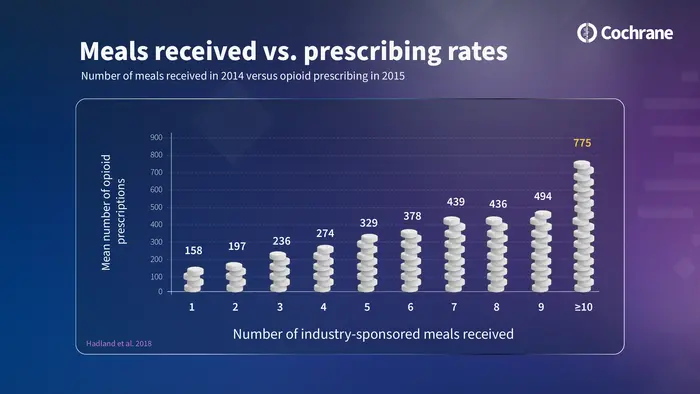
Notably, doctors receive food and drink gifts from pharmaceutical companies far more often than they receive consulting, advisory or speaking fees. These gifts typically have little monetary value. But the review shows a clear dose-response relationship between paid-for meals and inappropriate prescriptions.
“It’s very common for doctors to receive free meals from companies,” said lead author Dr. Barbara Mintzes from the University of Sydney in Australia. “Doctors often think that this is trivial and doesn’t influence them, that they ‘can’t be bought for the price of a sandwich,’ but the data shows this is an effective marketing strategy. The more free meals a doctor receives, the more likely they are to prescribe less appropriate or more expensive drugs.”
One study linked more meals to higher quantities and costs of long-acting insulin prescriptions. Another found that doctors prescribed 9.3% more opioids for each additional meal they received from drug companies in the previous year.
The overprescription of opioids is the most infamous example of pharmaceutical companies’ promotion exaggerating benefits and minimizing harms, Bero says.
This review found that even inexpensive meals increased opioid prescribing, and that the more payments a doctor received from opioid manufacturers, the more likely they were to prescribe dangerously high opioid doses. One study found that each 1% increase in payments was associated with an average of 50 additional daily doses.
The widespread inappropriate overprescribing of opioids has led to an epidemic of addiction and deaths from overdoses. But it is not an isolated incident, Bero said.
“Patients should be offered the most appropriate treatment for their condition, based on clinical evidence not industry marketing,” she said. “[The opioid crisis] was high-profile due to the significant harms involved, but the systems that enabled it are unfortunately considered business-as-usual within the industry. Interactions between pharmaceutical companies and prescribing physicians are widespread, and the harms they cause are rarely so visible.”
Which medicines were linked to industry payments?
The authors also examined studies that looked at what happened to prescribing outcomes when hospitals or medical schools introduced policies that limited doctors’ interactions with sales representatives, banned free samples, or restricted doctors from accepting gifts. Prescribers working under these policies prescribed fewer and more appropriate drugs, they found.
For example, psychiatrists working under stricter policies limiting contact with sales representatives were less likely to prescribe antipsychotics and antidepressants to children, including for uses not officially approved for them.
The research team called for stronger conflict-of-interest policies to protect public health, including rules prohibiting gifts, payments, and sales visits. They also recommended limiting doctors’ exposure to industry promotion during medical education and throughout their careers.
“Addressing pharmaceutical promotion isn’t about undermining trust in doctors, it’s about strengthening and protecting health systems so that patients always receive the most appropriate care,” Bero said.
Reference
Mintzes B, Lexchin J, Sutherland JM, et al. Pharmaceutical industry promotional interactions and prescribing outcomes: a Cochrane systematic review. Cochrane Database Syst Rev. 2026. doi:10.1002/14651858.CD013423.pub3.