









Key findings
- Tobacco companies belong to U.S. Chamber of Commerce affiliates in 80 countries.
- Industry executives hold leadership or advisory roles in about 27% of chapters.
- Philip Morris International and British American Tobacco dominated AmCham leadership roles globally.
Tobacco companies remain embedded in influential U.S. business groups worldwide, giving the industry a discreet and powerful channel to weaken regulation and undermine public health, a new study finds.
For decades, tobacco companies have used business groups and front organizations to oppose anti-smoking restrictions. A study published last month [May 2026] in Tobacco Control suggests the industry’s Chamber memberships abroad are more important than ever.
They give Big Tobacco a forceful way to push back on taxes, price measures, and regulations. They also help the industry promote newer nicotine products at a time when governments are grappling with how to legislate them amid mounting health concerns.
Tobacco companies belong to 80 chapters of the American Chamber of Commerce worldwide, the study shows. In about one-quarter of chapters with tobacco members, industry executives hold leadership or advisory roles. Nearly 60% of Chamber chapters with tobacco members took at least one documented position aligned with tobacco industry interests from 2010 to 2025.
“It’s an ally of the tobacco industry,” said study co-author Mary Assunta, who directs Global Research and Advocacy at the Global Center for Good Governance in Tobacco Control (GGTC).
That alliance has important public health consequences. Higher tobacco taxes, warning labels, and nicotine product restrictions are among the most effective anti-smoking tools. When those policies are weakened or delayed, preventable disease and death can follow. Tobacco kills more than 7 million people each year.
“The tobacco industry’s influence in a country undermines public health protections, weakens laws and leaves vulnerable populations exploited with cheaper recreational addictive products, including cigarettes or vaping devices,” the researchers wrote. “Through strategic engagement with trade and business networks, the industry is able to delay, weaken or derail regulatory reforms designed to reduce tobacco consumption and protect populations from harm.”
The researchers say AmChams’ influence has been documented in more than 60 countries over the past 15 years. They warn: “Public officials must be on alert and monitor AmCham activities related to tobacco in these countries.”
Researchers tracked tobacco industry ties worldwide
The U.S. Chamber of Commerce is the country’s largest business federation, representing more than three million businesses and associations. Through American Chambers of Commerce (AmChams), its global network reaches nearly 200 countries.
AmChams are independent business associations in host countries affiliated with or endorsed by the U.S. Chamber. They advocate for companies, trade, and investment while enjoying significant access to governments and global forums. In fact, the Chamber convened 40 ambassadors, 28 heads of state, and 80 minister-level engagements across 500 meetings last year alone.
“We inform our members with timely policy analysis and legal advice, connect them with leaders in business and government through world-class events and intimate gatherings, and equip them with tools and resources to help them succeed,” its website reads. The Chamber did not respond to a request for comment.
A pattern of dismantling anti-smoking protections
Article 5.3 of the World Health Organization’s tobacco control treaty requires ratifying countries to protect public health policy from tobacco industry interference. The U.S. has not ratified the treaty.
The study builds on evidence that business groups and third parties help the tobacco industry oppose public health measures. A landmark 2015 report found the U.S. Chamber and AmCham affiliates intervened in tobacco control debates in more than a dozen countries.
That report, along with a New York Times investigation, documented efforts to fight graphic health warnings, tobacco taxes, plain packaging, and advertising restrictions. Other reports have documented similar tactics.
The new study goes further by mapping AmCham activity across all World Health Organization (WHO) member states using evidence through 2025. Researchers reviewed chapter websites, publications, social media, policy submissions, and industry monitoring databases.
Dr. Britta Matthes, a research fellow with the Tobacco Control Research Group at the University of Bath, said it provides the most systematic and up-to-date picture yet of tobacco companies’ engagement with AmCham networks.
“That is valuable because it moves the discussion beyond individual examples and helps show the scale and persistence of these concerns,” she said.
Tobacco companies push beyond cigarettes
The U.S. Chamber of Commerce defends cigarettes and the tobacco industry’s interests, agrees Stanton Glantz, founding director of the UCSF Center for Tobacco Control Research and Education.
The difference now is that the industry is promoting e-cigarettes, heated tobacco devices, and oral nicotine pouches. It also uses sustainability messaging to recast itself as part of the solution. That can sow confusion, especially as young people face mixed messages about newer nicotine products.
“They are continuing to play their traditional role in fighting taxation and meaningful controls on illicit trade, but they have also become important allies of the new marketing efforts,” Glantz said.
Resisting tobacco taxes
AmCham chapters also opposed tobacco tax increases or excise policies in at least six countries, the study reports. In Poland, where PMI and BAT sit on AmCham’s advisory council, the chapter opposed amendments to proposed excise taxes. Those changes affected e-cigarettes, heated tobacco devices and e-liquids.
The industry often argues that higher taxes fuel illicit trade, reduce revenue, and hurt the economy, the researchers note. In fact, earlier this year, the European Commission received a large wave of anonymous, pro-industry arguments against a proposed tobacco tax increase. EU officials said the campaign was likely coordinated to distort public feedback.
“This framing obscures the inherent conflict of interest, as tobacco companies have a commercial incentive to oppose strong taxation policies while simultaneously seeking influence over regulatory processes,” the researchers wrote.
Promoting newer nicotine products
In addition, AmCham engagement amplifies industry messaging that prioritizes profits over health, the study shows. That includes pitching e-cigarettes and heated tobacco devices as “harm reduction” and “smoke-free” products. Those activities have intensified, says Assunta, because the industry now has a broader range of products to defend and promote.
In Slovakia, for instance, AmCham’s magazine published a feature titled “A smoke-free future for Slovakia.” The piece centered on an interview with Philip Morris Slovakia’s general manager. It presented the company’s push to replace cigarettes with heated tobacco products as a public health mission, despite emerging health risks.
One recent study found that e-cigarette use after quitting smoking may weaken some benefits, including lower lung cancer risk and death. Another reported that otherwise healthy young adults who regularly used e-cigarettes showed abnormal heart and lung responses during exercise.
“These narratives often rely on the arguments that nicotine, though addictive, is not the primary cause of smoking-related diseases, shifting the focus instead to combustion as the main source of harm,” the researchers wrote.
Burnishing tobacco companies’ image
AmCham-sponsored corporate social responsibility and community projects allow tobacco companies to portray themselves as responsible citizens rather than producers of harmful and addictive products.
The study found that AmCham chapters in 15 countries promoted or partnered with tobacco companies on community or environmental projects. They ranged from a volunteer day at schools to a journalism awards program framed around sustainability and rural development.
Why indirect influence matters
“You aren’t talking to Philip Morris. You’re talking to the Chamber of Commerce.”
Stan Glantz
Access is a key part of the equation. A government official may never meet directly with a tobacco industry representative. Instead, the Chamber can deliver industry-aligned messages while appearing to speak for the broader business community.
As Glantz said: “You aren’t talking to Philip Morris. You’re talking to the Chamber of Commerce.”
“People should be worried because when the tobacco industry uses AmCham as its front to undermine and to do all the things that it is actually not supposed to be doing, then government officials are not freed up to act in the best interests of public health,” said Assunta.
Researchers call for stronger tobacco lobbying safeguards
The authors note several limitations. For instance, the analysis relied solely on public records, so it may underestimate undisclosed tobacco industry ties.
The researchers urged governments to require disclosure of AmCham affiliations, partnerships, and policy alignment with tobacco companies. They also called for stronger bans on tobacco and nicotine advertising, promotion and sponsorship, and for a cessation-first approach.
“Policymakers and public health advocates can use this study to enhance transparency, limit industry influence in trade bodies and adopt stronger safeguards against conflicts of interest in policy making,” they wrote.
Reference
Niazi F, Sy DK, Assunta M, et al. “Chambers of secrets: how the US Chamber of Commerce advances tobacco industry agendas.” Tobacco Control. Published online May 4, 2026. doi:10.1136/tc-2025-059671
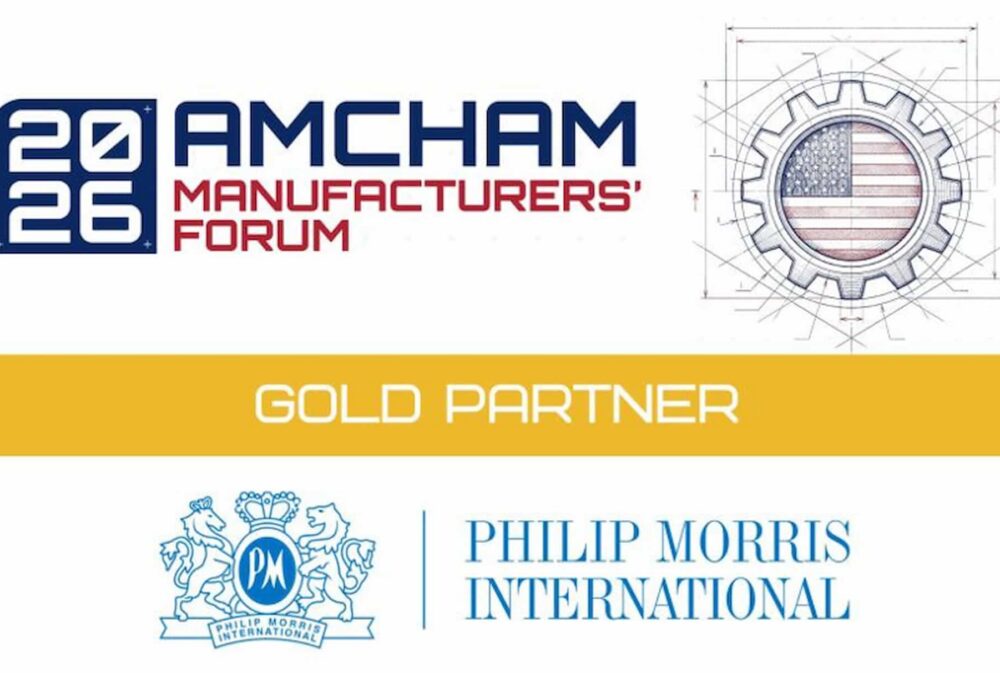
Photo: Philip Morris tobacco company was the “Gold Partner” at the March 2026 AmCham Manufacturers’ Forum in Poland.