







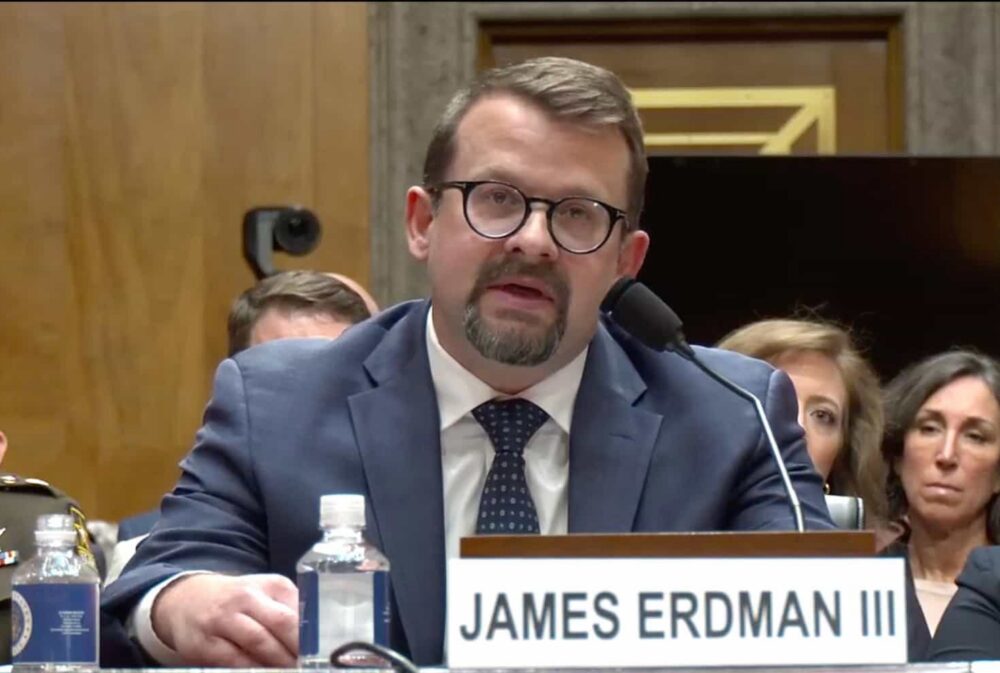
A retired CIA officer who helped review intelligence about the origins of the COVID-19 pandemic says he saw firsthand that reports being prepared for public release still showed what analysts concluded and why, even after details about intelligence sources and methods were removed. His sworn account, which a federal judge agreed to consider this week, challenges the government’s claim that it can release nothing more of substance from records sought by U.S. Right To Know.
James E. Erdman III said in his declaration that intelligence reports about the origins of the COVID-19 pandemic were sent to the Office of the Director of National Intelligence and other agencies to prepare them for public release. But aside from a single batch disclosed in June, he wrote, Erdman was unaware of any of the material becoming public.
U.S. Right To Know submitted Erdman’s nine-page declaration on Nov. 17 in its lawsuit against ODNI over the disputed records that it requested three years ago under the Freedom of Information Act (FOIA). The next day, U.S. District Court Judge David J. Novak allowed the nonprofit news group to file the declaration. Novak also accepted a supplemental brief and gave ODNI two weeks to reply. The agency’s motion to dismiss the case remains pending in the Eastern District of Virginia.
The lawsuit seeks intelligence records on possible links between the Wuhan Institute of Virology (WIV) and the origins of COVID-19, including records involving the Chinese research institute’s pre-pandemic coronavirus research, any work it did with or for China’s military and reports that its researchers fell ill in the fall of 2019.
Nearly seven years after the first known COVID-19 cases, the pandemic’s origins remain disputed and have yet to be definitively established. U.S. intelligence agencies have released some records, but many of the documents sought in this and other lawsuits remain heavily redacted or withheld in full.
In his declaration, Erdman wrote that scientific analysis ran throughout the COVID origins reports he reviewed while on assignment with a special ODNI task force. When details about collection methods and foreign governments were removed, he wrote, the redactions “left the scientific discussion, and the analytic judgments resting on it, intelligible to a reader.” Erdman’s statement also said he could not determine whether any of the reports he reviewed were among the records at issue in the lawsuit.
In an interview on Friday, Erdman said he agreed to provide his sworn statement for the lawsuit because he believes the government still hasn’t fully complied with the COVID-19 Origin Act of 2023, which called for wide disclosure of intelligence materials. In the declaration, he said he is not a party to the lawsuit and that neither side employs or pays him.
“Honestly, it’s a crime,” Erdman said. “It’s a crime to not actually release the information that should be made available to the American public.”
Neither ODNI nor the U.S. attorney’s office handling the case responded to emails seeking comment about Erdman’s declaration for this story. A spokesperson for the Defense Intelligence Agency, which also holds records subject to the lawsuit, declined to answer questions about Erdman’s statement, saying in an email the agency “does not comment on matters in litigation.”
Two laws call for disclosure of COVID origins records
The lawsuit began in 2023, after Congress gave the director of national intelligence 90 days to declassify information about possible links between the Wuhan Institute of Virology and the pandemic’s origins and submit an unclassified report to Congress. The COVID Origin Act of 2023 limited redactions in that report to those the director deemed necessary to protect intelligence sources and methods. ODNI issued a nine-page report that June. The same month, U.S. Right to Know sought the report’s underlying records, submitting a FOIA request for relevant intelligence records.
After U.S. Right to Know sued, ODNI began processing the requested records and has since released several batches, including records from the Defense Intelligence Agency. But many of the disclosed records were heavily or entirely redacted. The agencies cited classification justifications and disclosure exemptions that allow them to protect sources and methods for withholding those records.
Since passing the 2023 law, Congress has gone even farther in seeking COVID origins declassifications. It passed provisions in the National Defense Authorization Act of 2026 requiring the director of national intelligence and other intelligence agency heads to review, within 180 days, a broader set of records, including intelligence on possible natural origin, and ordered public release of related intelligence records. The law allowed some redactions to protect sources, methods and privacy information about U.S. citizens.
In June, ODNI released a batch of declassified COVID origins records in the days before former Director of National Intelligence Tulsi Gabbard left the agency. Erdman, who had been on loan from the CIA to the ODNI and tasked with investigating COVID origins under Gabbard, cited that batch in his court declaration.
The dispute before Judge Novak concerns what ODNI must disclose under FOIA. The law requires agencies to release any nonexempt portions of records that can reasonably be separated from protected material. ODNI maintains that it cannot separate further meaningful nonexempt information from the material it is withholding. But its review has already yielded additional disclosures. In a Nov. 10 court filing, the agency reported that further review led it to release more material on Nov. 4, including unclassified endnotes citing open sources.
Erdman’s declaration suggests more material can and should be released.
What Erdman saw
Erdman worked as a CIA operations officer and senior manager from 2013 until his retirement in June 2026. In April 2025, he joined the Director’s Initiatives Group, or DIG, a multiagency task force created by Gabbard. His work included investigating the pandemic’s origins and reviewing proposed redactions to intelligence products being considered for public release. In his declaration, he said he heard Gabbard repeatedly call for the release of COVID origins records.
Erdman also wrote that finished intelligence reports of the kinds he reviewed generally put details identifying or describing sources in numbered endnotes or distinct passages within the text. In the COVID origins reports he reviewed, he added, scientific analysis appeared throughout the body of the text.
“In the products I reviewed, removing the sourcing apparatus, the description of collection methods, and foreign government information, left the scientific discussion, and the analytic judgments resting on it, intelligible to a reader,” he wrote.
Two of the disputed records are types of defense intelligence reports that Erdman said he regularly reviewed in his assignment. ODNI’s index listing documents responsive to the FOIA request describes a third document as containing an assessment of what U.S. intelligence agencies did not know about COVID-19. Erdman wrote that describing a gap in intelligence does not, by itself, identify a source or collection method. Because the titles remain redacted, he could not identify any of the three records as a document he personally reviewed, however.
Matthew Hardin, the attorney representing U.S. Right To Know in the case, argued in his motion to file the declaration that Erdman’s observations give the court a factual basis to question ODNI’s account of what can be separated and released. Hardin opposed the government’s efforts to dismiss the case on that issue.
Before providing his declaration, Erdman sought a pre-publication review of his statements by the CIA. The agency cleared the declaration for publication on Nov. 13, according to the court filings.
ODNI has argued that Erdman needs additional CIA authorization to provide the declaration as testimony in the lawsuit. Hardin maintains that a voluntary written declaration requires no such authorization and has asked both agencies to grant it on an expedited basis to resolve that objection.
From Senate testimony to federal court
In May, Erdman testified under subpoena before the Senate Homeland Security and Government Affairs Committee, alleging that CIA analysts concluded several times between 2021 and 2023 that a lab leak was the most likely origin of the COVID-19 pandemic, and that intelligence officials later suppressed or altered those conclusions in official accounts.
In both the oral testimony and a written statement given to the committee, Erdman said ODNI, under its former director Avril Haines, did not conduct a serious declassification effort for documents covered by the COVID Origins Act, and that the intelligence community had simply ignored turning over thousands of pages of records that were subject to the law.
The CIA dismissed the proceedings as “dishonest political theater masquerading as a congressional hearing,” according to a statement by CIA spokesperson Liz Lyons.
The DIG was dissolved in January 2026. Erdman, who also co-founded Feds for Freedom, a nonprofit formed by federal employees who opposed COVID-19 vaccine mandates, returned to the CIA before retiring at the end of June.
In a call on Friday, Erdman told U.S. Right To Know that the CIA slowed the interagency review and that his DIG team got “non-answers” from the office responsible for processing the material for release. He added that the task force could submit records for review but lacked authority to declassify them itself.
“If we did,” he said, “we would have just declassified it and done it.”
Drew Carmichael, a spokesperson for Sen. Rand Paul, R-Ky, who chaired the May committee hearing, said in an email that the intelligence community still has not complied with the 2023 law.
“Jim Erdman saw firsthand the COVID-origins intelligence the government was keeping from the American people, and he had the courage to testify publicly before our committee,” Carmichael said. “He now says under oath that he personally reviewed proposed redactions and that, to his knowledge, material intended for public release is still being withheld. The American people deserve to see it.”
Erdman has also prepared a declaration for a separate U.S. Right to Know lawsuit against the CIA. That case seeks intelligence cables exchanged with France’s foreign intelligence service about early COVID-19 cases and related subjects. The declaration, which the CIA has also approved for publication, has not yet been filed publicly, and it remains uncertain whether it will become part of the court record.
Since launching its investigation into COVID origins in 2020, U.S. Right To Know has filed 320 public records requests and 46 lawsuits seeking records from the CIA, ODNI, FBI and other agencies, has obtained and posted online more than 280,000 pages of records, and has written scores of articles reporting on those records.