







Of the many chemicals humans have invented to control agricultural pests, some of the most devious are called “insect growth regulators.” As the name suggests, these compounds don’t kill insects directly; they alter their development so they can’t grow into healthy, reproducing adults. This makes insect growth regulators a remarkably useful tool for taming populations of insects like whiteflies and mealybugs, which can spread diseases and sap nutrients out of food crops.
There’s just one problem: Farmers don’t want to regulate all insects in this way. Beneficial insects like honey bees risk getting caught in the crosshairs of these chemicals, to the detriment of farmers who need their pollination services to produce crops like pears and cherries.
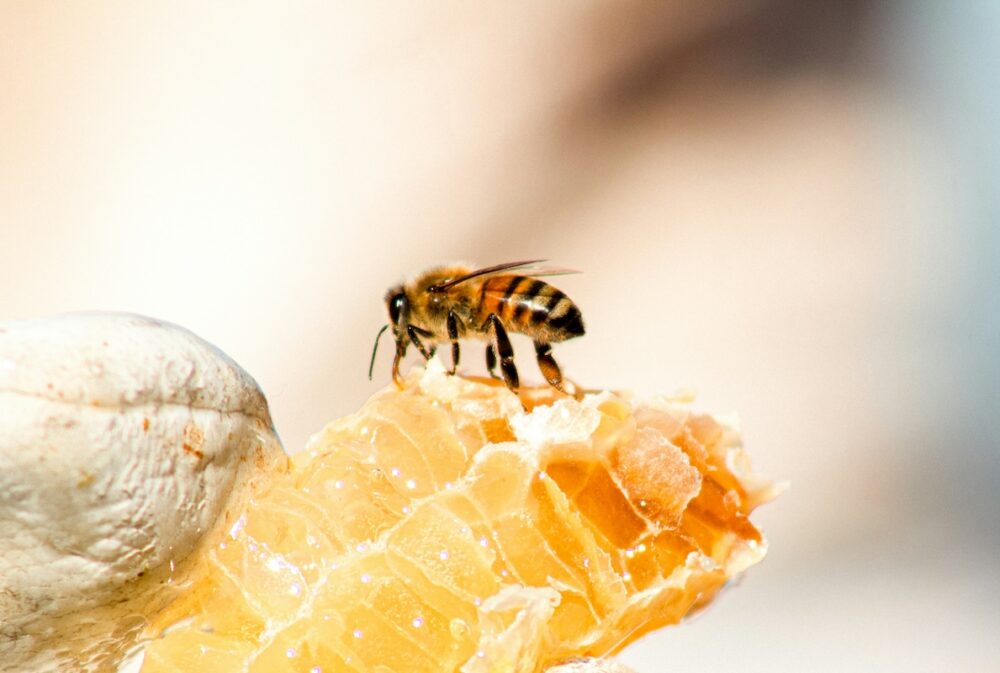
One insect growth regulator in particular has emerged as a potential issue for pollinators: buprofezin. Ongoing research out of Washington State University, or WSU, suggests that buprofezin may be hazardous to honey bees even at concentrations 10 times below those commonly found in pollen. A study published in 2024 connected the compound to “severe brood mortality.”
At a meeting of the Washington State Beekeeping Association last month, WSU entomology professor Brandon Hopkins said buprofezin products should be sold with a pollinator warning — a break from current requirements of the U.S. Environmental Protection Agency, or EPA.
Buprofezin “should carry the same bee-caution label that some of these more direct pesticides carry,” Hopkins told U.S. Right to Know. “What we want to do is help increase some of the communication and education around the use of this … to just reduce exposure.”
Buprofezin use has increased rapidly since 2000
Buprofezin was developed in the 1980s by a Japanese agrichemical company called Nihon Nohyaku. It was officially registered in the U.S. in 2000 and sold by one of the company’s subsidiaries, Nichino America, initially under the trade name Applaud.
Farmers at first adopted the pesticide to address booming populations of whiteflies in California and Arizona. Use spread quickly through the aughts and 2010s, and more than 350,000 pounds of the chemical were sprayed on U.S. crops annually by 2018, according to the Pesticide National Synthesis Project. That year, the heaviest applications were concentrated along the West Coast, in several mid-Atlantic states, and in Florida and Texas — largely on tree fruits and cotton.
For most of this history, farmers could assume that buprofezin targeted only the insects killing their crops. EPA guidance said there were “no restrictions that would prevent application to the crops during bloom,” while buprofezin products were labeled with a message saying they were “not harmful to beneficial insects.”
But the evidence against that idea has slowly mounted. In 2019, the EPA told companies to remove the “not harmful” language from their product labels, as effects to “nontarget” insects like pollinators “cannot be precluded.” The agency’s preliminary ecological risk assessment identified three papers published between 2000 and 2006 suggesting the chemical could kill developing bumblebees and ladybugs, though it didn’t find any studies looking at chronic effects on insect larvae to provide a stronger basis for regulation.
The EPA received at least one study from Nichino of these chronic impacts. That study, however, isn’t publicly available, and the EPA didn’t respond to U.S. Right to Know’s request to view it or discuss its findings. A comment from Nichino didn’t acknowledge questions about the larval bee study but expressed the company’s commitment to “pursuing initiatives that harmonize agricultural progress with ecological well-being,” in line with EPA regulations.
Researchers link ‘extreme brood mortality’ to buprofezin
Hopkins didn’t set out to study buprofezin specifically; his 2022-2023 research project looked at a range of pesticides affecting honey bees as they moved from crop to crop over two pollination seasons. He and his research partners only turned their attention to the insect growth regulator once they started observing “extreme levels” of dead brood both inside and in front of bee hives.
“We saw hundreds of thousands of [dead bees],” said Ge Zhang, a former assistant professor at WSU and lead author on the paper describing their findings. (Zhang is now a professor of entomology at Shandong Agricultural University in China.) Zhang said he found high concentrations of buprofezin in honey bee pollen across hives, and that larval mortality was particularly high right after pollination of fruit trees.
High levels of buprofezin “caused long-term effect on honey bee health,” the paper said. “Bee colony populations could not be sustained,” and they lacked the ability to “reproduce sufficient new generation of adult bees, leading to colony mortality late in the season.”
“This instance of brood poisoning by buprofezin presents an alarming scenario that highlights a need to monitor pesticide exposures in honey bees under natural conditions in the field as well as a need to implement regulatory policy changes surrounding pesticide safety,” the paper added.
Reed Johnson, an entomology professor at the University of Ohio who was not involved in the research, said the paper was “well-done.” Even though the connection between bee mortality and buprofezin is not yet definitive, it’s “entirely plausible” that an insect growth regulator would harm honey bee larvae. “This is exactly the sort of effect you would expect to see,” he told U.S. Right to Know. “I think it goes a long way toward explaining the colony problems that [beekeepers] are seeing.”
Since then, Hopkins’ lab has been conducting further research into buprofezin thanks to funding from the research nonprofit Project Apis m. This is the work that Hopkins talked about at that Washington bee conference. In one experiment, he exposed colonies to different concentrations of buprofezin, including one that was 10 times lower than the “field-relevant” dose of 10 parts per million. Again, he saw “huge” amounts of mortality. Sixty-four to 79 percent of bees died when fed the pesticide, compared to just 5 percent dying in a control group.
Those findings haven’t yet been written up or peer-reviewed, and Hopkins wants to do further lab work.
He said buprofezin products, including those marketed by Nichino, should carry a pollinator warning. These messages are required for other compounds like imidacloprid, one of the neonicotinoid pesticides connected to bee die-offs. They warn that the product “can kill bees and other insect pollinators,” and provide some specific application instructions to help minimize the risk of exposure. Hopkins said an appropriate label for buprofezin should tell farmers not to spray while their crops are in bloom and attracting honey bees.
In response to U.S. Right to Know’s request for comment, a Nichino spokesperson said EPA-approved labels are “legally enforceable documents that manufacturers cannot change without required authorization.”
The EU is already restricting buprofezin on human health grounds
Barbara Berardi Tadié, a senior policy officer for the nonprofit Pesticide Action Network Europe, agreed with the idea of a warning label for buprofezin, or even a complete ban on spraying during the blooming season.
The EU is already taking more aggressive steps, although its actions are based on concerns about human health rather than pollinators. Way back in 2017, the European Commission banned buprofezin on edible food crops like tomatoes and lettuce after researchers had shown that buprofezin residues could break down into aniline, a probable human carcinogen. The Commission went further last month and approved a total ban, citing evidence that the compound is an endocrine disruptor for humans. Studies in rats and dogs have linked buprofezin to increased thyroid weight, which can lead to breathing problems and is often a sign of an underlying hormonal disorder.
A report from the European Food Safety Authority couldn’t find any conclusive data on endocrine disruption in insects. Tadié said the agency is now unlikely to seek more pollinator data, as “there are enough reasons to ban [buprofezin].”
In the U.S., the EPA has yet to finalize its re-registration of buprofezin; it still needs to complete a formal endocrine disruptor evaluation and determine whether the pesticide affects any plants and animals listed under the Endangered Species Act. The agency missed a deadline to finish re-registration for buprofezin and hundreds of other pesticides earlier this month and is now expected to receive a five-year extension under a proposal in the 2026 Farm Bill.
Short of official restrictions or an EPA-mandated label, Hopkins said tree-fruit organizations and other agricultural industry groups could mount an education campaign telling farmers not to apply buprofezin at certain times. They could also voluntarily develop a set of best practices for orchard management, taking into account different bloom times for pears, apples, cherries, and other crops that are often planted right next to each other.
Neither the Washington State Tree Fruit Association nor the International Fresh Produce Association responded to U.S. Right to Know’s request for comment. A spokesperson for the U.S. Apple Association said they hadn’t had an opportunity to review the buprofezin research, but they told U.S. Right to Know that “honey bees and other pollinators are absolutely essential to apple production, and protecting their health is a priority for our growers.”
Indeed, farmers pay hundreds of millions of dollars for bees’ pollination services each year and have a material interest in protecting their health. The U.S. Apple representative pointed to pollinator protection guidelines their organization co-developed with the Honey Bee Health Coalition and called for “continued research, education and collaboration among growers, researchers, beekeepers and regulators.”