









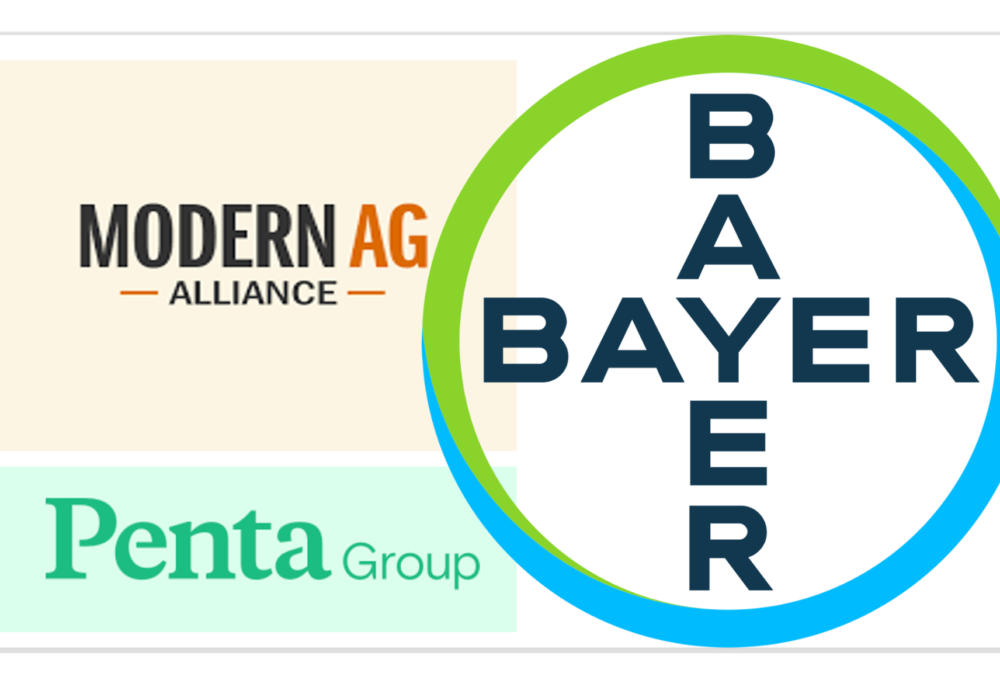
The Modern Ag Alliance, launched by Bayer in 2024, enables the company to lobby and campaign through an entity that looks like a coalition of farm organizations, not a single giant chemical corporation.
MAA represents itself as a “diverse coalition, founded by Bayer, that today represents more than 110 agricultural organizations.” But public records suggest it functions as a front group for Bayer’s interests.
Tax records reveal that a Bayer vice president sits on the board of directors, and nearly all of its budget has gone to a public relations firm that also works for Bayer.
Bayer itself describes the MAA as a key part of its lobbying. The company has portrayed the MAA – whose tagline is “Pesticides power America’s ag” – as its strategy for “fighting back” against glyphosate concerns and lawsuits.
MAA is a 501(c)(4) nonprofit organization, a structure that allows it to raise unlimited funds for advocacy or lobbying while keeping donors secret. Bayer has not answered questions about whether it funds MAA.
The tax records show that MAA raised $15.6 million in 2024, and spent $13 million – nearly all its reported expenses – on “advertising and consulting costs” to a single PR firm: the Penta Group. Bayer is also a client of the Penta Group, according to PR Week and Politico. The tax filings also show that MAA received $8.6 million in in-kind contributions for advertising and agency services; these are donated services, not purchased with cash.
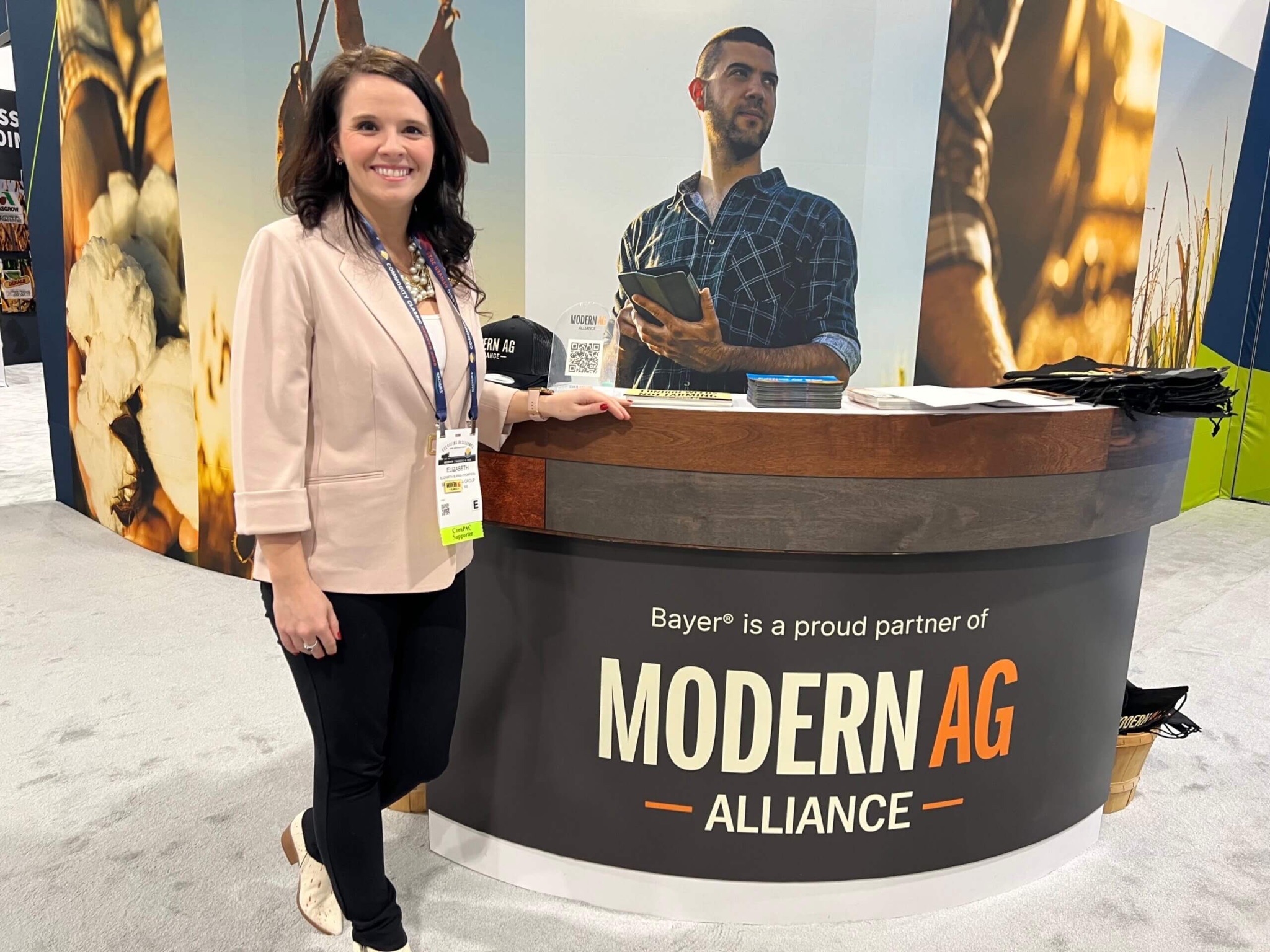
Bayer executives regularly promote the Alliance and speak at public events under its branding. For example, Bayer CropScience communication lead Jessica Christiansen, and Martha Smith, Bayer’s head of North American agriculture affairs, appear in media interviews, press releases or events promoting MAA, and in news stories that promote the legislative goals of the MAA.
The objective of MAA is to shape the outcome of the high-stakes “failure to warn” debate over whether Bayer can be held liable under state law for not warning users that glyphosate-based herbicides may pose cancer risks. Bayer argues that EPA-approved pesticide labels should shield it from lawsuits, while opponents argue that federal approval should not erase a company’s duty to warn consumers when evidence of harm emerges. The outcome could determine whether Bayer can be held liable in court if its products cause harm.
Who is behind the Modern Ag Alliance?
Disclosed members of the Modern Ag Alliance include large agribusiness trade groups, and national and state commodity crop growers’ groups. Many of these groups have financial relationships with Bayer and other pesticide firms, via sponsorships, partnerships or direct funding, though these ties are often opaque.
The MAA Board of Directors are:
- Hallie Utley, Bayer vice president for state and local government affairs;
- Will Bentley, president of the Georgia Agribusiness Council, a tax-exempt trade group that receives Bayer sponsorships;
- Steve Taylor, president of the Missouri Agribusiness Association, a tax-exempt trade group with a Bayer employee on its board (Samantha Davis, Bayer’s director of stakeholder relations);
- Elizabeth Burns-Thompson, executive director of the Modern Ag Alliance.
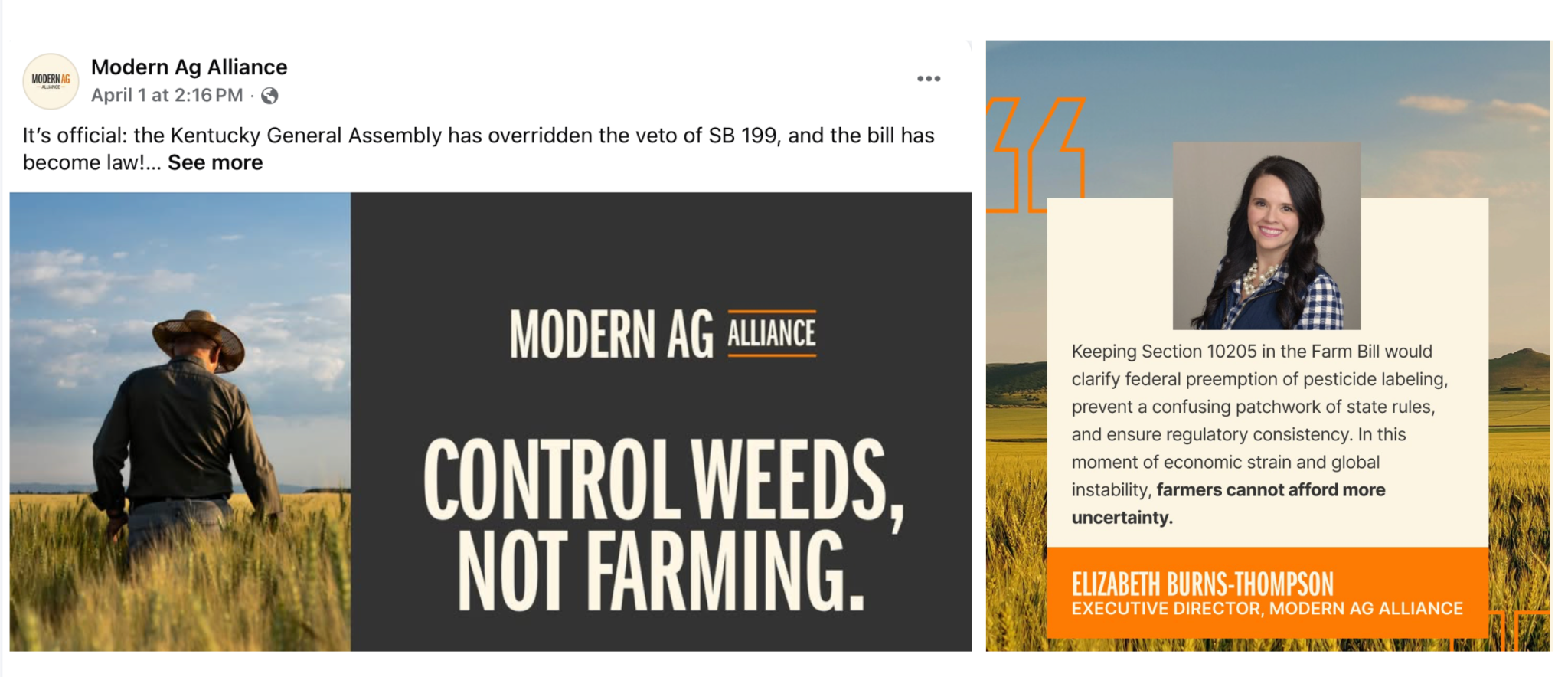
The MAA tax return shows 40 hours a week of employment for Burns-Thompson but lists no salary, leaving it a mystery as to who is paying her. Burns-Thompson is the only person listed on the MAA website. She appears at agricultural conferences and in the media to argue that restricting glyphosate would harm U.S. agriculture.

Bayer’s vehicle for state lobbying
While Bayer maintains a large traditional lobbying presence in Washington DC, the Modern Ag Alliance is a campaign to protect Bayer’s products, specifically glyphosate, at the state level.
According to its website, the MAA lobbies for legislation that EPA pesticide registrations are sufficient for health-and-safety warning purposes. This would make it harder for Americans to use state-law failure-to-warn claims to sue pesticide manufacturers for cancer and other injuries.
North Dakota and Georgia passed bills in 2025 to make federally approved pesticide labels the legal standard for safety, limiting lawsuits that claim companies should have provided stronger cancer or health warnings. Kentucky enacted a similar law in 2026 after lawmakers overrode the governor’s veto.
MAA is running state-level campaigns across the farm belt to pass similar immunity bills, with hundreds of thousands of dollars spent in several states. Recent investigations indicate that cancer rates are rising faster than the national average among young adults in corn-growing states.
In Idaho, MAA was the top out-of-state lobbyist in 2025, spending more than $620,000 on a single immunity bill for pesticide manufacturers (it never advanced out of committee).
In Iowa – where Bayer itself spent record amounts on lobbying last year – MAA “spent more than $250,000 between January 2024 and March 2025 to flood Iowa’s radio airways with over 3,300 ad spots promoting glyphosate,” Food and Water Watch reported. Bayer-backed immunity bills failed twice in Iowa, but supporters are expected to try again. The effort is not popular with the public: a 2024 poll found that 89% of respondents in Iowa opposed pesticide immunity legislation, including 87% of Republican respondents.
In Missouri, more than $350,000 went to radio and TV ads supporting Bayer’s legislative positions; MAA spent $180,000 on ads promoting glyphosate, while a group called the Protecting America Initiative “used emotional political messages painting opponents of the legislation as dupes helping China gain control of American agriculture,” the Missouri Independent reported. (Bayer denied having any role in the Protecting America ads).
The MAA advertises heavily on social media too – without disclosure of Bayer’s key role. In the first three months of 2025, Modern Ag Alliance spent about $171,000 on Meta ads alone. Posts on MAA Facebook page include photos of farmers, MAA member groups with ties to Bayer, and messaging from corporate-funded PR groups, such as the Breakthrough Institute and CFACT.
Pro-pesticide campaign to counter the rise of MAHA
Bayer’s aggressive lobbying push responds in part to the rise of the “Make America Healthy Again” (MAHA) coalition that wants to reduce pesticide exposures to protect public health. Recent polls suggest a large majority of Americans want the government to reduce pesticide use. An April 2026 Reuters poll reports that 78% of Americans are “concerned about pesticide use in food crops,” while a recent Pew poll found that five out of six American adults want the government and businesses to do more to ensure chemical safety and increase transparency.
Some Trump administration officials indicated a willingness to take action; an early draft of the administration’s MAHA commission report cited glyphosate and atrazine – the two most widely used herbicides in the U.S., and both linked to cancer – as contributors to chronic health problems.
But the final MAHA report removed those concerns. Industry lobbyists held frequent, high-level meetings with EPA and HHS officials, according to FOIA records obtained by Investigate Midwest. Representatives from Bayer, other pesticide firms, and MAA members attended these meetings with administration officials who themselves have ties to Bayer.
The Modern Ag Alliance touted the final MAHA report as a partial win, noting that “farmers’ voices were finally heard” but complaining that the report “advanced some misconceptions” about the “gold-standard science and regulatory processes that stand behind” pesticides.
Bayer messaging echo chamber
Spokespeople from Bayer and other MAA members – many of which receive funding from Bayer and other pesticide companies – appear together at events and in media interviews repeating similar messaging.
The 2024 Farm Progress Show at the University of Iowa – sponsored by Bayer, BASF, and other pesticide firms – featured a discussion about “glyphosate access concerns” moderated by Bayer’s Martha Smith. Speakers from the Iowa Soybean Association and the Agribusiness Association of Iowa – both of which partner with Bayer – argued that glyphosate is safe and EPA should have the final say on pesticide regulations.
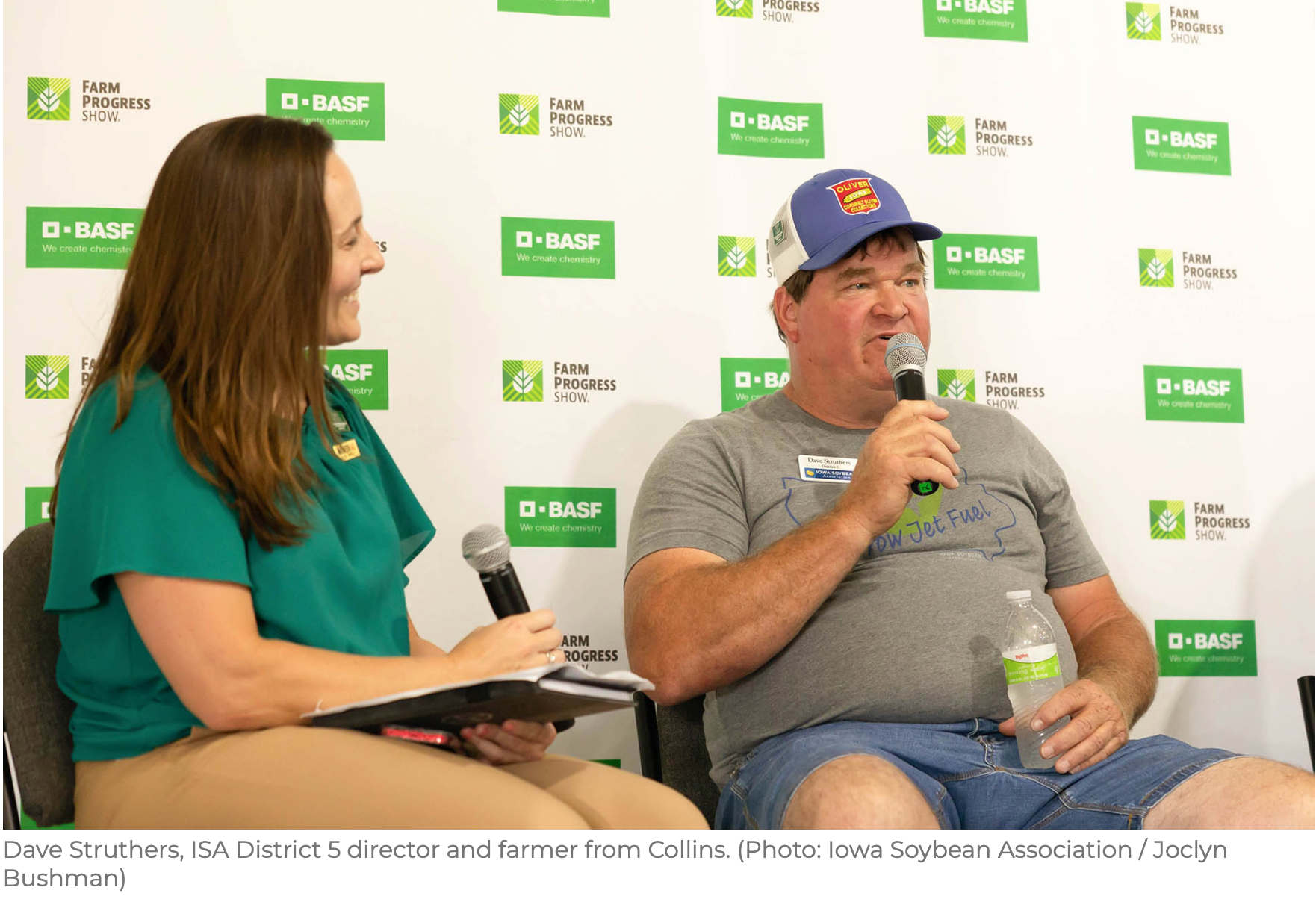
In this example of Bayer’s messaging echo chamber, Bayer’s Maggie Smith prompts Dave Struthers of the Iowa Soybean Association to give his message to lawmakers. Struthers claims that EPA testing has shown glyphosate is not dangerous. In reality, EPA generally does not do its own testing and relies heavily on industry data for pesticide approvals; a federal court rejected the EPA’s glyphosate assessment in 2022 because, among other problems, it failed to adequately assess cancer risk.
Modern Ag Alliance hosted a similar discussion at the Commodity Classic 2025, an event sponsored by Bayer and other pesticide and agribusiness firms that drew more than 11,000 people to Denver. The Alliance panel discussed “anti-ag activists attacking… EPA-approved herbicides like glyphosate,” and speakers from commodity crop trade groups “underscored the consequences of the relentless, often meritless, litigation and the urgent need for a legislative fix.”
Bayer also introduced a new product there: Vyconic genetically engineered soybean seeds that resist five herbicides: dicamba, glufosinate, mesotrione, 2,4-D and glyphosate.

Bayer’s business model is to produce seeds and pesticides for commodity crops that mostly go to feed cows, cars and ultra-processed food factories. Because weeds are now resistant to glyphosate, Bayer and other pesticide companies are genetically engineering seeds with multiple “stacked traits,” so they may produce insecticides (Bt crops) and tolerate multiple herbicides at once. The U.S. government does not require additional safety studies for stacked traits even though independent studies suggest the health risks are amplified.
Concerns about EPA pesticide approvals
One of Bayer’s top 2026 goals is to ensure that EPA-approved labels fulfill all “duty to warn” requirements. Critics oppose this effort because EPA pesticide approvals are deeply flawed; they rely heavily on industry-submitted data and are not designed to address the full range of potential health effects or to rapidly incorporate emerging scientific research.
Courts have repeatedly found EPA decisions inadequate, and independent studies have often identified harms years after pesticides were approved. For example, pesticides such as chlorpyrifos and atrazine have retained EPA approval despite evidence of health risks.
Advocacy groups also note that EPA rarely requires clear cancer warnings on pesticide products, even in cases where the agency or other scientific bodies have identified possible cancer risks. As a result, critics argue that EPA approval have not kept pace with evolving scientific evidence.
Penta Group accused of deceptive survey tactics
Penta Group formed in 2023 with the merger of eight PR, polling and analytics companies; it was acquired by Shamrock Capital (a Disney family-founded private equity firm) in 2025 and now serves “more than half of Fortune 50 companies,” with more than half its $100 million revenue coming from “proprietary AI, data and predictive analytics work,” Axios reports.
Penta Group also works for Bayer in the European Union. In 2023, French MEP Manon Aubry accused Penta of “breaching the Transparency Register’s code of conduct over a survey it sent to parliamentary assistants,” Politico EU reported.
Aubry’s complaint to the Register accused Penta of “failing to identify which clients it’s operating on behalf of” and “dishonestly obtaining data and opinions under the guise of nonpartisan research,” Politico reported. The survey asked policy professionals to provide “candid feedback” on a range of issues, including the war in Ukraine, and to describe how they perceived various corporations including Bayer, Exxon and Microsoft – all Penta clients at the time.
The Modern Ag Alliance has also used Penta surveys without disclosing the group’s role as a PR firm servicing Bayer. An “ag insights survey” claiming “Americans are deeply concerned” about litigation against pesticide manufacturers describes Penta as “an independent polling firm.”
Read more of our reporting on pesticide industry PR and influence campaigns:
- Tracking the pesticide industry propaganda network: Fact sheets documenting the industry connections of the many front groups, spin groups and academics who promote and defend agrichemical industry products.
- Merchants of Poison report: Analysis of internal corporate documents reveals key tactics Monsanto and Bayer used to protect profits from glyphosate.