

For months, U.S. Secretary of Health and Human Services Robert Kennedy Jr. has crisscrossed the nation advancing his Make America Healthy Again (MAHA) agenda — spotlighting plans to crack down on unhealthy ultra-processed foods, and praising state-level efforts to restrict chemical food additives and bolster consumers’ right to know.
At least 90 proposals in dozens of states seek to restrict, ban or label ultra-processed food or synthetic ingredients. The push is based on strong scientific evidence that the poor health of many Americans may arise in part from eating so much ultra-processed food.
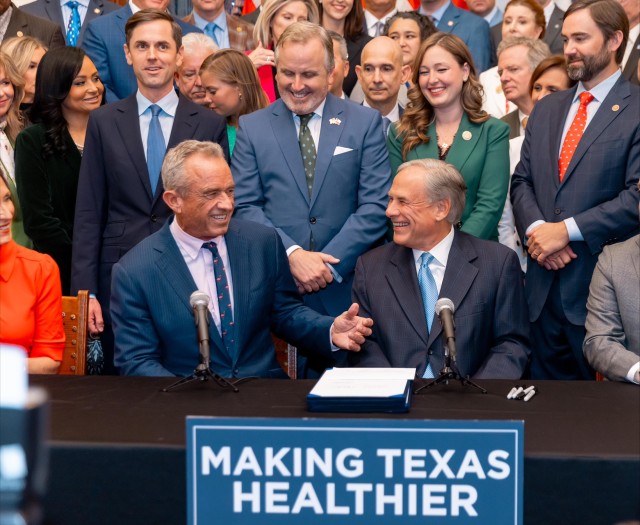
“We have more chronic disease than any country in the world, and we know what it is, and we know it’s the food that we’re eating, it’s environmental causes,” Kennedy said this summer, as Texas Gov. Greg Abbott (R) signed the first state law requiring warning labels on 44 artificial additives or food chemicals not allowed in other countries.
When West Virginia passed the first state law banning several food dyes from school lunches (and eventually from all foods sold in the state), HHS praised the effort in a press release, commending “the 24 states pushing MAHA bills to clean up our food system…”
But last week, in an interview with Bloomberg’s Kristina Peterson, Kennedy struck a different note – one that appears to align with ultra-processed food companies. A national food standard is “on the table for discussion,” Kennedy said. “The fact that this is being driven by the states has brought the industry to the table with us because they don’t want to have rules in 50 different markets; that’s impossible.”
This framing echoes Big Food’s talking points: that state laws are too complex or burdensome, and Congress should therefore enact a single national food safety standard – one that would override state laws. Public health advocates oppose federal preemption because it often replaces tougher state laws with a weaker federal one.
The food industry is clearly in a panic over recent state-level successes. Last month, Coca-Cola, Kraft, General Mills and other big brands launched a new PR and lobbying salvo. Their core mission: override state laws with a uniform national food standard.
Where does Kennedy stand on gutting state food laws?
Sec. Kennedy’s meaning isn’t entirely clear, and his office didn’t respond to requests for comment. He told Bloomberg that discussions about food safety are focused on “making sure we have a standard that is working for the states and working for the federal government, and that works for industry.” He said he thinks the Trump administration will “have to go back to Congress and get statutory authority to have a national standard,” if one could be agreed upon.
“For years, the federal government has failed Americans by allowing unsafe food additives that are banned in other countries, including petroleum-based food dyes, to penetrate our diets.”
State leaders are wary. Republican State Senator Laura Wakim Chapman of West Virginia, who championed her state’s food dye ban as “probably the most important bill that we will vote on in our entire careers,” told U.S. Right to Know: “While I would love to see a national food safety framework, I would hope that the big food lobby is unable to sway the safety standards to the point of making them meaningless.”
She continued, “For years, the federal government has failed Americans by allowing unsafe food additives that are banned in other countries, including petroleum-based food dyes, to penetrate our diets. If the federal government fails us, the states should still have the opportunity to protect its citizens through its constitutional police powers including regulations to protect the health, safety, and general welfare of its people.”
Local laws typically protect health ‘more strenuously’
Federal preemption occurs when a federal law overrides state or local laws, preventing states and local governments from exerting their authority in a particular policy area, even if their laws provide stronger protections.
“State and local governments traditionally protect the health and safety of their populations more strenuously than does the federal government,” explains a key 2017 American Journal of Public Health article by Jennifer Pomeranz, a public health law professor at New York University, and Mark Pertschuk, director of Grassroots Change and the Preemption Watch project.
The authors advise: “Stakeholders across public health fields and disciplines should join together in advocacy, action, research, and education to support and maintain local public health infrastructures and protections.”
Read more about how Big Food is responding: